- UEI: Z66VQCUPCGL3 CAGE: 9UK94
- +1 844-539-2555
- Sales@NationalBatterySupply.com

How to Charge a Deep Cycle Marine Battery?
Nobody teaches this stuff. That is the whole problem.
You buy a marine battery, the guy at the counter says “good choice,” you drive home, grab whatever charger you already own, plug it in. Works fine. You feel like you handled it. Then six or eight months later the battery is basically useless and everyone assumes it was a dud.
It got quietly destroyed by the wrong charging process, done over and over, until the damage passed the point where recovery was possible. National Battery Supply hears some version of this story all the time. So here is what actually needs to happen.
The Car Battery Thing Needs Addressing First
Because this is where most people go wrong and it is worth being blunt about it.
A car battery is designed to release one giant burst of current, it is enough to spin a starter motor and then basically do nothing for the rest of the day while the alternator handles everything. That is the entire job. And car batteries are not built for deep discharge. Drain one down to 50 percent repeatedly and it will die faster than it should. That is just the chemistry.
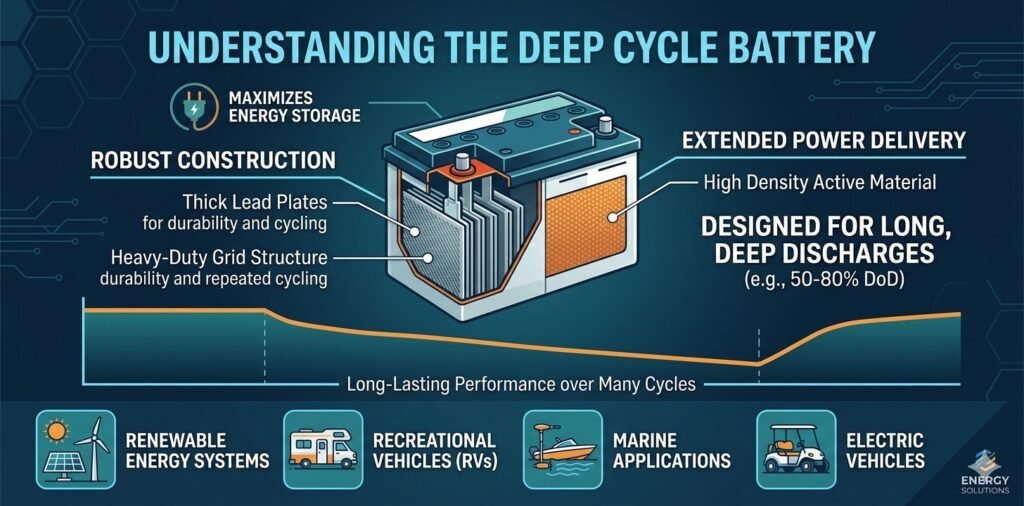
Deep cycle marine batteries are built for the opposite situation entirely. Slow, steady drain over hours. Trolling motor running all morning. Fish finder, live well, bilge pump, maybe lights. Everything draws from the same battery for a full day on the water. Then recharge that night. Then go again next weekend.
Different jobs. Different internal construction. Different charging needs.
So the automotive charger sitting in the garage? Put it back. It pushes voltage too aggressively for a deep cycle battery. The battery will not refuse to accept the charge. It will just wear out faster and faster, quietly, until one trip makes the problem impossible to ignore.
Choosing a Charger That Is Actually Right for the Battery
The Chemistry Problem Most People Do Not Know Exists
Here is something that does not get explained at the point of sale nearly enough. Deep cycle marine batteries are not all the same internally.
Flooded lead-acid. AGM. Gel. Lithium iron phosphate. Four different chemistries, four different charging profiles. A charger built for flooded lead-acid pushes higher absorption voltage than a gel battery wants. A charger calibrated for AGM may not terminate correctly on a lithium battery. This is not minor. Using the wrong charging profile shortens the battery’s usable life in ways that are invisible until they are not.
The charger lists compatible battery types. Match it. That is the whole instruction.
Amps – The Part Everyone Skips
Voltage matching is the easy part. Amp rate is where people make quiet mistakes.
Rough rule worth knowing: charge rate should not exceed roughly ten to twenty percent of the battery’s amp-hour rating. 100Ah battery means 10 to 20 amps maximum. Go above that and the battery runs warm. Consistent heat during charging degrades the internal plates. Not immediately. Over months.
And honestly, slow charging is not just the cautious option. It is the better option full stop. A battery that gets charged at a low amp rate over eight or ten hours will genuinely outlast one that gets pushed hard every time. Not a small difference over a couple of seasons.
Get a Smart Charger and Stop Thinking About It
A smart charger monitors the battery state throughout the entire process and adjusts automatically. It steps through the charging stages on its own and stops when the battery is actually full. Not when a timer runs out. When the battery is done.
A basic charger keeps pushing until someone physically unplugs it. Which means overcharging is entirely dependent on the owner remembering. That is an unreliable system and everybody knows it.
Smart charger. Not optional at this point.
Before the Cables Go On
This part gets skipped almost universally. It should not.
Main power switch off before anything else. Then actually look at the battery rather than just grabbing the cables.
Check the terminals. Marine environments are brutal involving moisture, salt air, engine fumes. Corrosion builds up fast and that crusty white or greenish buildup is not just surface grime. It is electrically resistant material sitting between the terminal and the cable. Badly corroded terminals mean the battery will not charge to its real capacity no matter how long the charger runs.
Baking soda mixed with a bit of water, old toothbrush, scrub it off. Dry everything completely before connecting anything.
On flooded lead-acid batteries, check the cell water levels. If the plates are sitting above the electrolyte, top up with distilled water only. Tap water has dissolved minerals that get into the cells and contaminate them. This is a ten second check that most people skip for years and then wonder why the battery is underperforming.
One more thing. Ventilation. Lead-acid batteries produce hydrogen gas during charging. Hydrogen in a closed compartment is genuinely dangerous. Not a worst-case-scenario concern. An actual one.
Connecting and Monitoring
Red to positive first. Black to negative second.
This order exists for a reason. Reverse the cables and the best case outcome is a spark. Worst case is worse than that.
Plug the charger in, set the amperage, let it run.
What to watch while it charges:
- Full charge voltage for lead-acid and AGM sits between 12.6 and 12.8 volts
- Lithium iron phosphate reads higher at full charge, around 13.6 volts
- A battery reading below 12.4 volts at rest has not finished charging regardless of what any indicator claims
- Warm during charging is normal. Hot is not. Hot means the amp rate is too high or the charger chemistry is wrong
Bulk, Absorption, Float
Most people have no idea what a charger is actually doing across those eight or ten hours. There are three stages and they are all doing something different.
Disconnecting during bulk because several hours have passed and that feels like enough, leaves the battery at maybe 75 percent. It will seem charged. The light might even show charged. But absorption never completed. The battery never hit full capacity.
Do that fifty times across a season and a half and the battery starts acting old. Nothing dramatic. Just steadily less capable than it should be.
How These Batteries Die Before They Should
None of these are dramatic. That is what makes them hard to catch.
- Regular deep discharge below 50 percent. Once in a while is fine. Every trip is not
- Wrong chemistry setting on the charger, used for months without visible consequence
- Overcharging with a basic charger because nobody unplugged it in time
- Charging in a hot compartment or direct sun. High ambient temperature accelerates internal degradation in a measurable way
- Corroded terminals that nobody cleaned, ever. Battery never reaches full charge but the indicator eventually shows green so nobody questions it
- The car charger from the garage. Still coming up. Probably always will
Conclusion
None of this is complicated. But it is specific. Right charger chemistry. Amp rate the battery can handle. Terminals clean before every connection. Charge running through all three stages before disconnecting.
Those things done consistently are what separates a battery that lasts three years from one that lasts its full rated life.
For anyone replacing a battery that was never charged right, the deep cycle batteries at National Battery Supply cover every marine chemistry with specs clear enough to get the match right before any of this becomes a problem worth fixing.
Featured Posts
Request more information
National Battery Supply delivers dependable energy storage solutions tailored to commercial, industrial, and government applications. Our catalog ranges from custom battery manufacturing and UPS systems, portable power stations, to high-capacity solutions like whole-home battery energy storage systems (BESS) and scalable containerized energy storage units- engineered for reliability, flexibility, and rapid deployment.
We support critical infrastructure, telecom, data centers, healthcare, and remote operations with power systems built for performance in demanding environments. Whether it’s deep cycle batteries, lithium forklift replacements, OEM portable power kits, solar backups, and large-scale energy storage systems. We provide tailored solutions with short lead times, custom branding, and bulk pricing.
Our team also specializes in helping integrators, resellers, and developers source complete battery systems for residential microgrids, off-grid power stations, and industrial container setups. Whether you need to back up a home, energize a remote site, or manage facility-wide loads, we have the scalable energy storage options to match.
Contact us today to learn how our advanced power systems can reduce downtime, extend operational capacity, and support your long-term energy goals.

National Battery Supply is a reputable manufacturer specializing in custom battery solutions. With over 20 years of experience, we can manage all your power needs.
Batteries
Compliance
Copyright 2026 © National Battery Supply | UEI: Z66VQCUPCGL3 CAGE: 9UK94