- UEI: ZZVQCUPCGL3 CAGE: 9UK94
- +1 844-539-2555
- Sales@NationalBatterySupply.com
What Solar Charge Controller Do I Need for Lithium Batteries?
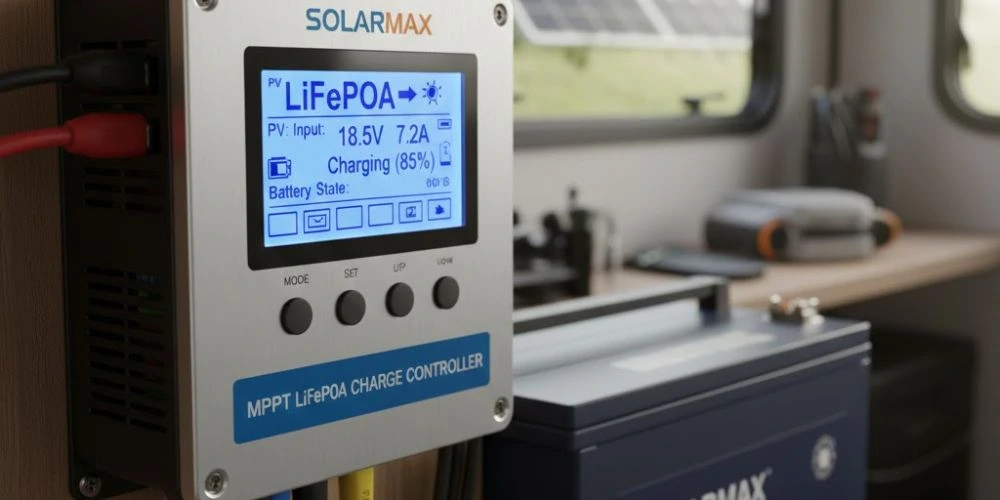
If you’re building your first solar system or upgrading to LiFePO4 batteries and you’ve felt overwhelmed, you are not alone. You need a solar charge controller that speaks lithium language because LiFePO4 batteries need specific charging profiles to avoid overcharging or undercharging and to extend cycle life. Get the wrong controller and you could shorten battery life or limit energy harvest, leaving you frustrated and out of pocket.
This guide explains how to choose the right controller by matching your solar array size, battery voltage, and system needs while maximizing energy capture and protecting your investment. Shop lithium ready solar controllers and LiFePO4 batteries at NationalBatterySupply.com for reliable performance and expert support (per trusted solar system sizing methods) (per real user experiences).
PWM vs MPPT: Which Solar Charge Controller for Lithium Batteries
When choosing a controller for lithium batteries, many DIY solar builders quickly learn that PWM controllers just can’t keep up with lithium charging needs in most real world systems. PWM controllers work like a simple on/off switch that pulls panel voltage down to battery voltage, and they are cheap. However, they lack the precision and efficiency that lithium batteries require, and they usually don’t provide programmable lithium charge settings.
In contrast, MPPT controllers such as those from Victron SmartSolar, Renogy Rover Li, and Morningstar TriStar use maximum power point tracking to constantly optimize the power from your solar array and can convert excess voltage into additional current with up to 25 to 30 percent higher efficiency than PWM units (per solar engineering guides).
MPPT controllers also commonly include lithium specific settings like precise absorption voltage targets needed by LiFePO4 cells. That extra efficiency matters most when your array is larger than about 200 watts, when conditions are variable like morning or evening light, or when you need to protect expensive lithium battery banks from improper voltage.
PWM might work for tiny off grid projects under 100 watts, but it risks slow charging and battery damage because most basic PWM units do not let you set correct LiFePO4 voltage parameters. Real users repeatedly say that MPPT squeezed way more power out of their panels than PWM and that Bluetooth apps on MPPT controllers helped them avoid overcharging once they understood settings (per solar installer community feedback).
The bottom line is that if you are serious about lithium and want reliable performance and efficiency, MPPT is the right choice for most systems.
How to Size a Solar Charge Controller for Lithium Batteries?
Sizing your solar charge controller correctly is one of the most practical steps to avoid heat issues, shutdowns, and underperformance. Start by calculating the maximum current your solar array can produce. Divide the total panel wattage by your battery bank voltage to get a baseline current.
For example, a 400 watt array feeding a 12 volt LiFePO4 bank produces roughly 33 amps. Add about 25 percent buffer to that number so the controller has headroom for real world peaks, shading changes, and future expansion. That example points you toward a controller rated around 41 amps, so a 50 amp MPPT controller is a smart choice.
Common Real World Configurations
Common real world configurations include 20 to 30 amp controllers for small RV or boat systems with 200 to 600 watts of panels, 40 to 60 amp for mid sized setups between 800 and 1500 watts, and 100 amp plus controllers for larger off grid homes or cabins.
Do not undersize your controller because it can overheat, go into fault mode, or shorten life, and oversizing slightly helps you grow without swapping gear. Next confirm voltage compatibility. Modern MPPT controllers including many from Victron and Renogy automatically detect 12, 24, or 48 volt banks and adjust appropriately.
Always verify your controller’s max PV input voltage rating and make sure it exceeds your panel open circuit voltage, especially in cold weather when Voc increases, to avoid damaging the controller. Pair this with LiFePO4 specific charge settings including correct absorption and float targets and you protect your battery investment.
Many controllers offer Bluetooth or app monitoring from brands like Joyvoit or ECO WORTHY so you can watch real time voltage and current and tweak settings to match your exact battery specs. Avoid lead acid only controllers which typically overvolt lithium cells and shorten battery life.
Pick the Right Controller for Your Lithium Solar Setup
For lithium batteries, you want to prioritze MPPT solar charge controllers that include dedicated LiFePO4 charge profiles and are sized at least 25 percent above your expected array amps so you avoid heat and fault conditions. Match the controller voltage to your battery bank, check that the controller supports your panel’s open circuit voltage, and choose reputable brands like Victron, Renogy, ECO WORTHY, or Morningstar for longevity and support.
That proper selection maximizes energy harvest, protects your investment, and ensures reliable power day in and day out. With app based monitoring you can watch how your system performs and make adjustments that extend battery life. Browse solar charge controllers and lithium batteries at NationalBatterySupply to build a system that meets your goals and gives you confidence in your off grid or mobile power setup.
Featured Posts
Request more information
National Battery Supply delivers dependable energy storage solutions tailored to commercial, industrial, and government applications. Our catalog ranges from custom battery manufacturing and UPS systems, portable power stations, to high-capacity solutions like whole-home battery energy storage systems (BESS) and scalable containerized energy storage units- engineered for reliability, flexibility, and rapid deployment.
We support critical infrastructure, telecom, data centers, healthcare, and remote operations with power systems built for performance in demanding environments. Whether it’s deep cycle batteries, lithium forklift replacements, OEM portable power kits, solar backups, and large-scale energy storage systems. We provide tailored solutions with short lead times, custom branding, and bulk pricing.
Our team also specializes in helping integrators, resellers, and developers source complete battery systems for residential microgrids, off-grid power stations, and industrial container setups. Whether you need to back up a home, energize a remote site, or manage facility-wide loads, we have the scalable energy storage options to match.
Contact us today to learn how our advanced power systems can reduce downtime, extend operational capacity, and support your long-term energy goals.

National Battery Supply is a reputable manufacturer specializing in custom battery solutions. With over 20 years of experience, we can manage all your power needs.
Batteries
Compliance
Copyright 2026 © National Battery Supply | UEI: ZZVQCUPCGL3 CAGE: 9UK94