- UEI: Z66VQCUPCGL3 CAGE: 9UK94
- +1 844-539-2555
- Sales@NationalBatterySupply.com

How to Test a Marine Battery Safely?
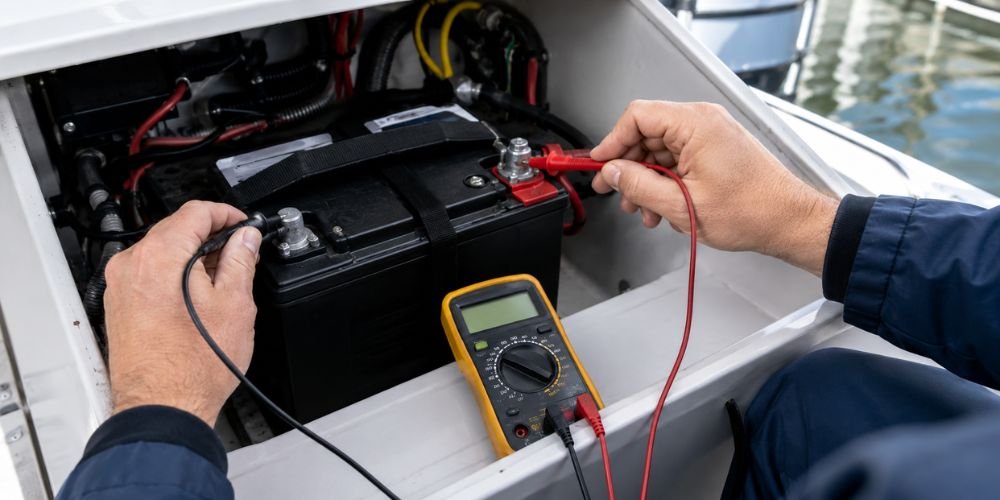
To test a marine battery, first fully charge the battery, check its resting voltage with a multimeter, perform a load test, and check the battery’s ability to maintain voltage under load. A healthy 12V marine battery should read around 12.6V to 12.8V after a full charge and rest period, while a reading below 12.4V may indicate a partially discharged or weak battery.
Confirm the Battery Type First
Marine batteries are built for starting, deep cycling or both jobs. A starting battery delivers high current for a short period. A deep cycle battery supplies steadier power to trolling motors, pumps, lights and electronics. A dual purpose model handles both tasks with some compromise.
Chemistry changes the test. Flooded lead acid batteries may allow electrolyte checks. AGM and gel batteries stay sealed. Lithium iron phosphate batteries often rely on a battery management system for useful health data. The explanation of AGM marine battery differences helps show why one method cannot suit every battery.
Look for Trouble Before Using a Meter
The battery should be disconnected from charging sources and boat loads unless a tester requires another setup. Eye protection and gloves are sensible around lead acid batteries. Metal jewelry should stay away from exposed terminals.
A swollen case, leaking fluid, a crack or unusual heat calls for an immediate stop. A strong rotten egg smell can indicate gas or internal trouble. Such a battery belongs with a trained professional.
Terminal condition matters too. Green corrosion, loose clamps, damaged cable ends and weak grounds can cause slow cranking. A voltage reading at the posts may look normal while current struggles through a poor connection.
Charge the Battery Before Judging It
A partly discharged battery cannot give a fair health result. It should receive a full charge from equipment designed for its chemistry and voltage. The wrong profile may leave it undercharged or expose it to excessive voltage.
The guide to charging a deep cycle marine battery explains the basic differences between flooded, AGM, gel and lithium charging.
After charging, the battery needs time to rest with loads and chargers removed. This allows surface charge to settle. The manufacturer may specify an exact period. When no figure is available, at least one hour gives a more useful reading than testing straight away.
Take a Resting Voltage Reading
A digital multimeter should be set to DC volts. The red probe touches the positive post. The black probe touches the negative post. Contact should be made with the posts rather than dirty clamp surfaces.
A fully charged 12 volt lead acid battery often rests near 12.6 to 12.8 volts. A result close to 12.4 volts usually suggests partial charge. A reading around 12.0 volts points to heavy discharge. Temperature, chemistry and design can shift those numbers, so the maker’s chart remains the better reference.
Open circuit voltage shows charge level more clearly than capacity. An aging battery may display a respectable number with no load, then fall sharply once the starter turns. Lithium voltage also stays fairly flat through much of its usable range. BMS information may reveal more in that case.
See What Happens Under Load
A load test checks whether voltage holds when the battery is asked to work. The battery must be fully charged first.
For a lead acid starting battery, a suitable tester may apply a load equal to half the printed CCA rating for about 15 seconds. The pass level depends on temperature and tester instructions. Guesswork has no place here. Bridging the posts with a tool is dangerous and proves nothing.
An electronic conductance tester estimates available cranking performance without a heavy discharge. A poor result should still be checked against the terminals, cables and starter.
Test Deep Cycle Capacity Properly
A brief cranking test does not show how long a deep cycle battery can run equipment. Capacity testing uses a known load and records operating time before the battery reaches the manufacturer’s cutoff voltage.
This procedure takes longer and needs controlled equipment. Running random boat accessories until everything shuts down gives only a rough impression. It may also take the battery below a safe discharge limit.
Lithium batteries need particular care because the BMS may disconnect the pack at its programmed threshold. Manufacturer instructions should control the setup.
Check Flooded Cells With a Hydrometer
A hydrometer can test specific gravity in serviceable flooded batteries after a full charge. Each cell is measured separately. Readings are compared with the manufacturer’s chart and corrected for temperature when required.
One cell that stays noticeably lower than the others may indicate an internal problem. AGM, gel and lithium cases must not be opened for this test.
Rule Out Problems Elsewhere
A healthy battery can keep going flat when the alternator, onboard charger or wiring is at fault. Charging voltage should be measured while the approved source operates. The correct range depends on battery chemistry and the equipment fitted to the boat.
Parasitic draw is another common suspect. Bilge pumps, stereos, damaged wiring and forgotten accessories can continue pulling power after shutdown. Repeated discharge after a successful battery test deserves an electrical inspection before another battery is purchased.
Conclusion
A dependable result comes from several clues: physical condition, full charge, resting voltage, performance under load and chemistry specific checks. One reading rarely tells the whole story.
When the case is damaged or the battery repeatedly fails a correct test, available Marine Batteries can be compared by duty type, chemistry, capacity, physical size and charger compatibility. That match matters more than price alone.
Featured Posts
Request more information
National Battery Supply delivers dependable energy storage solutions tailored to commercial, industrial, and government applications. Our catalog ranges from custom battery manufacturing and UPS systems, portable power stations, to high-capacity solutions like whole-home battery energy storage systems (BESS) and scalable containerized energy storage units- engineered for reliability, flexibility, and rapid deployment.
We support critical infrastructure, telecom, data centers, healthcare, and remote operations with power systems built for performance in demanding environments. Whether it’s deep cycle batteries, lithium forklift replacements, OEM portable power kits, solar backups, and large-scale energy storage systems. We provide tailored solutions with short lead times, custom branding, and bulk pricing.
Our team also specializes in helping integrators, resellers, and developers source complete battery systems for residential microgrids, off-grid power stations, and industrial container setups. Whether you need to back up a home, energize a remote site, or manage facility-wide loads, we have the scalable energy storage options to match.
Contact us today to learn how our advanced power systems can reduce downtime, extend operational capacity, and support your long-term energy goals.

National Battery Supply is a reputable manufacturer specializing in custom battery solutions. With over 20 years of experience, we can manage all your power needs.
Batteries
Compliance
Copyright 2026 © National Battery Supply | UEI: Z66VQCUPCGL3 CAGE: 9UK94