- UEI: Z66VQCUPCGL3 CAGE: 9UK94
- +1 844-539-2555
- Sales@NationalBatterySupply.com

How Many Amp Hours Does a Deep Cycle Battery Have?
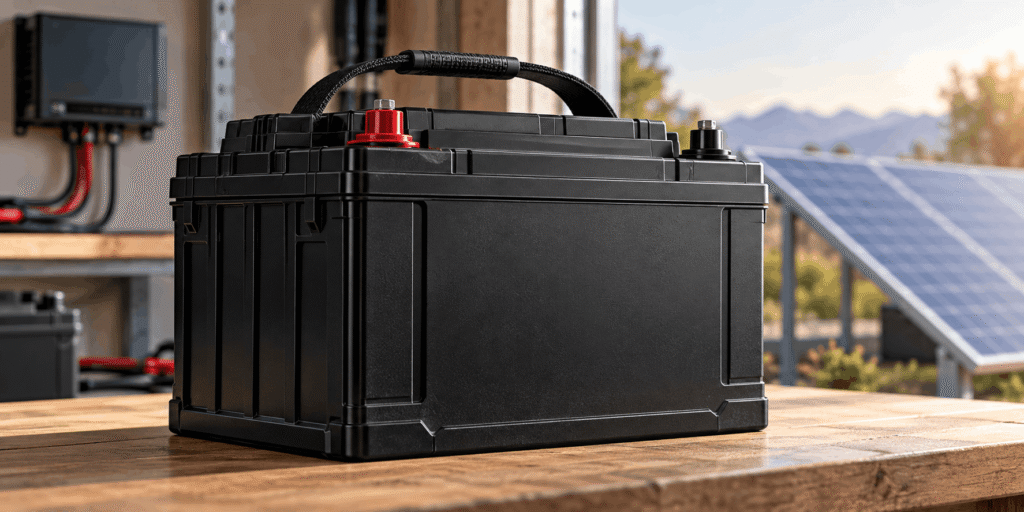
Most 12V deep cycle batteries are commonly available in capacities such as 50Ah, 75Ah, 100Ah, 125Ah, 150Ah, and 200Ah. For example, Renogy sells 12V deep cycle AGM batteries rated at 100Ah and 200Ah, while Trojan offers 12V deep cycle models around 100Ah to 130Ah at the 20-hour rate.
For buyers comparing batteries through National Battery Supply, the useful number is the one that matches the job. The question of how many amp hours are in a deep cycle battery therefore starts with the label, the battery chemistry and the rate used to measure that capacity.
Is There a Standard Amp Hour Rating?
There is no standard Ah figure for every deep cycle battery. Small batteries may sit around 35Ah or 50Ah. A common 12V size may be around 100Ah. Larger flooded 6V batteries used in RVs, golf carts, and renewable energy banks can exceed 200Ah.
The number alone can be misleading without the rest of the specification. Two batteries sitting side by side can be meant for very different workloads despite similar cases.
A 100Ah battery is not simply better than a 75Ah battery. It stores more charge at its stated test rate, but it may also be larger, heavier or unsuitable for the charger already in use. Space, voltage and chemistry still have to match the equipment.
The company’s guide to amp hour ratings is useful when the Ah label itself is the confusing part.
What Does the Ah Number Actually Mean?
Amp hours describe how much electrical charge a battery can deliver over time.
A 100Ah rating is often explained with simple maths. In theory, 5 amps for 20 hours equals 100Ah. Ten amps for 10 hours also equals 100Ah.
A fridge cycles. A trolling motor may spend ten minutes working hard then half an hour at a lighter setting. An inverter has its own losses. Cold weather can also reduce available performance. Battery age eventually joins the list.
That is why Ah works best as a capacity rating, not a promise of exact runtime.
Voltage has to stay in the picture too. A 12V 100Ah battery represents roughly 1,200 watt-hours of nominal energy. A 24V 100Ah bank represents roughly 2,400 watt-hours. The Ah figure is unchanged, but the energy available is not.
Why Can the Same Battery Show Two Ah Ratings?
Lead acid battery capacity is often published at a particular hour rate, such as the 20-hour rate. A battery tested slowly can show more usable capacity than the same battery discharged much faster.
For example, Trojan lists one 12V AGM battery at 83Ah at the 5-hour rate and 104Ah at the 20-hour rate. Nothing has been added to the battery. The test simply asks it to deliver current at a different pace.
That’s important when a battery will power a large load. The label from a slow discharge test cannot be assumed to indicate guaranteed capacity under any load.
Lithium batteries operate differently under load, yet their own manufacturer ratings and discharge restrictions still matter.
How Much Capacity Does the Job Need?
Suppose a piece of equipment draws 8 amps and normally runs for 6 hours. The simple calculation gives 48Ah. That is only the starting point. Battery chemistry, allowable depth of discharge and a margin for real-world losses still need to be considered.
When power use is listed in watts, the calculation can start there:
Watts × hours used = watt hours
Then:
Watt hours ÷ system voltage = amp hours
A 600Wh daily load on a 12V system works out to about 50Ah before extra capacity is allowed.
A battery should not be sized so tightly that an ordinary long day leaves it completely drained. The article on deep discharge effects explains why repeated heavy discharge can shorten the useful life of many batteries.
What Happens When Batteries Are Joined Together?
Battery banks create another easy point of confusion.
Two identical 12V 100Ah batteries connected in parallel make a 12V 200Ah bank. The voltage stays the same while capacity increases.
Put those same batteries in series and the result is 24V at 100Ah. Voltage doubles. Ah does not.
That difference matters in RV, marine, solar and backup systems. Someone counting battery cases without checking the wiring can easily overestimate or underestimate the bank.
Batteries used together should also be compatible. Mixing different capacities, chemistries or batteries with very different ages can lead to uneven performance.
Why Does Runtime Shrink With Age?
A battery can still charge while holding noticeably less energy than it did when new.
The change tends to show up during ordinary use. A trolling motor needs a recharge earlier. An RV inverter shuts down sooner. Backup lights no longer last through the same outage.
Repeated cycling, poor charging, heat and long periods at a low state of charge can all reduce capacity. At that stage, the Ah figure printed on the case describes the original rating rather than what the battery can still deliver today.
A proper capacity test is more useful than guessing from age alone.
Conclusion
There is no single Ah number that defines a deep cycle battery. The right capacity depends on voltage, load, expected runtime, chemistry and how deeply the battery will normally be discharged.
When a replacement or new system is being planned, National Battery Supply’s Deep Cycle Batteries provide a useful starting point for comparing capacities against the work the battery actually needs to do. The best fit is rarely just the biggest Ah number on the shelf.
Featured Posts
Request more information
National Battery Supply delivers dependable energy storage solutions tailored to commercial, industrial, and government applications. Our catalog ranges from custom battery manufacturing and UPS systems, portable power stations, to high-capacity solutions like whole-home battery energy storage systems (BESS) and scalable containerized energy storage units- engineered for reliability, flexibility, and rapid deployment.
We support critical infrastructure, telecom, data centers, healthcare, and remote operations with power systems built for performance in demanding environments. Whether it’s deep cycle batteries, lithium forklift replacements, OEM portable power kits, solar backups, and large-scale energy storage systems. We provide tailored solutions with short lead times, custom branding, and bulk pricing.
Our team also specializes in helping integrators, resellers, and developers source complete battery systems for residential microgrids, off-grid power stations, and industrial container setups. Whether you need to back up a home, energize a remote site, or manage facility-wide loads, we have the scalable energy storage options to match.
Contact us today to learn how our advanced power systems can reduce downtime, extend operational capacity, and support your long-term energy goals.

National Battery Supply is a reputable manufacturer specializing in custom battery solutions. With over 20 years of experience, we can manage all your power needs.
Batteries
Copyright 2026 © National Battery Supply | UEI: Z66VQCUPCGL3 CAGE: 9UK94