- UEI: Z66VQCUPCGL3 CAGE: 9UK94
- +1 844-539-2555
- Sales@NationalBatterySupply.com

How To Check Golf Cart Batteries Properly?
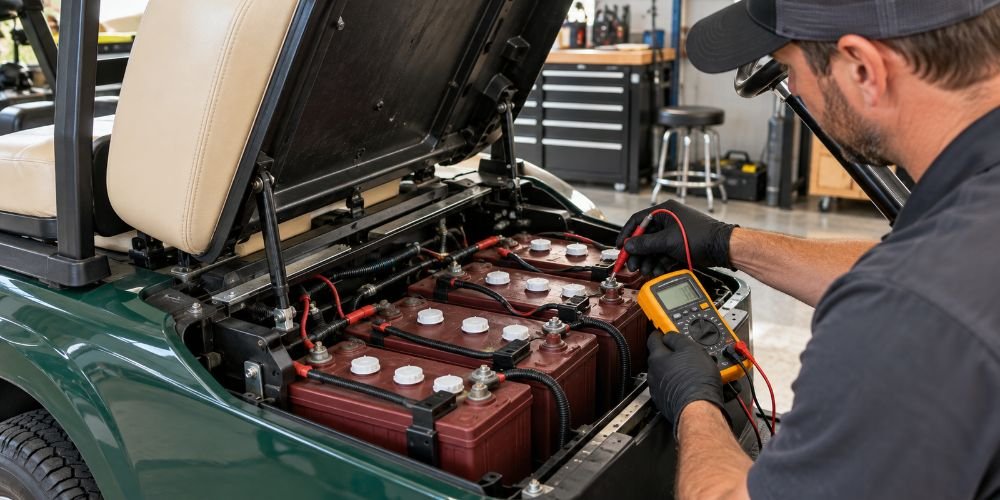
Check golf cart batteries with a digital multimeter after the batteries are fully charged and have rested for about 30 minutes.
National Battery Supply helps customers find suitable battery solutions for different applications. A correct diagnosis before replacement can save time and prevent spending money on parts that are not actually causing the issue.
Look For Warning Signs First
A golf cart rarely loses performance overnight. The decline usually happens slowly enough that owners adjust without noticing.
A cart that used to handle a full day of use but now needs charging after a short trip is showing an early warning sign. The same applies when acceleration feels weaker or the cart struggles more than usual on slopes.
Common signs of battery trouble include:
- Reduced driving distance after charging
- Slower movement under load
- Longer charging cycles
- Corrosion around terminals
- Battery cases showing leaks or damage
- The cart losing power quickly after sitting unused
Storage can also affect performance. A cart that has been parked for months may not perform the same way when brought back into regular use. Batteries naturally lose charge during long periods of inactivity, especially when maintenance is overlooked.
Before testing begins, it helps to note when the problem appears. A cart that loses power immediately under heavy use points towards a different issue than one that slowly fades after several hours.
Inspect The Battery Condition
A visual inspection is the simplest place to begin. Many battery issues can be noticed without any testing equipment.
The cart should be turned off before opening the battery compartment. The batteries, cables and connections should then be checked carefully.
Look for:
- Corrosion around terminals
- Loose cable connections
- Cracked battery cases
- Swelling or unusual shapes
- Dirt buildup around connection points
Corrosion around terminals can restrict the flow of power. Even if the batteries themselves are healthy, a poor connection can make the cart feel weak.
For flooded lead-acid batteries, fluid levels also need attention. Low electrolyte levels can expose the internal plates and reduce battery performance. Distilled water is generally used for topping up these batteries, following the manufacturer’s instructions.
A clean battery compartment also makes future inspections easier. Dirt and moisture can hide small problems until they become harder to ignore.
How To Test Battery Voltage?
Voltage testing gives a clearer idea of what is happening inside the battery pack. A digital multimeter is commonly used for this check.
The batteries should be fully charged before testing, then allowed to rest for a period so surface charge does not affect the reading. A reading taken immediately after charging may not show the true condition of the battery.
Each battery should be checked individually rather than only testing the complete pack. One weak battery can reduce the performance of the entire system.
During testing, owners should compare the readings between batteries. A noticeable difference can indicate that one battery is weaker than the others.
A voltage check can reveal:
- Batteries that are not holding charge
- Uneven performance within the pack
- Possible charging issues
- Batteries approaching the end of their useful life
However, voltage alone does not always tell the complete story. A battery may show an acceptable reading while still losing power when the cart is working.
Why Load Testing Matters
A golf cart does not use power while sitting still. The batteries work hardest when the cart accelerates, carries weight or climbs an incline.
This is why load testing provides useful information. It checks how well a battery performs when demand increases.
A weak battery may appear normal during a simple voltage check but drop quickly once power is required. This is often the reason a cart feels fine in the morning but struggles later in the day.
Load testing is usually better handled with proper equipment because batteries produce significant current. A professional test can show whether the battery is losing capacity rather than simply needing a charge.
For owners noticing repeated performance issues, checking the battery under load can prevent replacing the entire set when only one component has failed.
How To Maintain Golf Cart Batteries
Battery checks are useful, but everyday habits have a major effect on battery life.
Many battery problems develop because small maintenance tasks are skipped. A cart may sit unused through a season, terminals may collect corrosion and charging may become inconsistent.
Helpful habits include:
- Charging after regular use
- Keeping terminals clean
- Checking connections occasionally
- Avoiding long periods of complete discharge
- Following charger recommendations
The correct maintenance routine depends on the battery type. Flooded batteries require different care compared with sealed or lithium options.
Choosing the right battery also matters when replacements are needed. The voltage, size and power requirements must match the golf cart specifications.
For owners comparing replacement options, golf cart batteries can help identify suitable solutions based on the cart’s requirements rather than simply choosing the cheapest option.
Conclusion
Checking golf cart batteries does not require guessing. Looking for warning signs, inspecting connections, measuring voltage and testing performance under load can reveal what is actually happening.
When batteries no longer hold charge properly or the cart cannot deliver reliable performance, replacement may become the practical choice. National Battery Supply provides Golf Cart Batteries designed to support dependable performance for different golf cart applications.
Featured Posts
Request more information
National Battery Supply delivers dependable energy storage solutions tailored to commercial, industrial, and government applications. Our catalog ranges from custom battery manufacturing and UPS systems, portable power stations, to high-capacity solutions like whole-home battery energy storage systems (BESS) and scalable containerized energy storage units- engineered for reliability, flexibility, and rapid deployment.
We support critical infrastructure, telecom, data centers, healthcare, and remote operations with power systems built for performance in demanding environments. Whether it’s deep cycle batteries, lithium forklift replacements, OEM portable power kits, solar backups, and large-scale energy storage systems. We provide tailored solutions with short lead times, custom branding, and bulk pricing.
Our team also specializes in helping integrators, resellers, and developers source complete battery systems for residential microgrids, off-grid power stations, and industrial container setups. Whether you need to back up a home, energize a remote site, or manage facility-wide loads, we have the scalable energy storage options to match.
Contact us today to learn how our advanced power systems can reduce downtime, extend operational capacity, and support your long-term energy goals.

National Battery Supply is a reputable manufacturer specializing in custom battery solutions. With over 20 years of experience, we can manage all your power needs.
Batteries
Compliance
Copyright 2026 © National Battery Supply | UEI: Z66VQCUPCGL3 CAGE: 9UK94