- UEI: Z66VQCUPCGL3 CAGE: 9UK94
- +1 844-539-2555
- Sales@NationalBatterySupply.com

How to Store a Boat Battery for Winter?
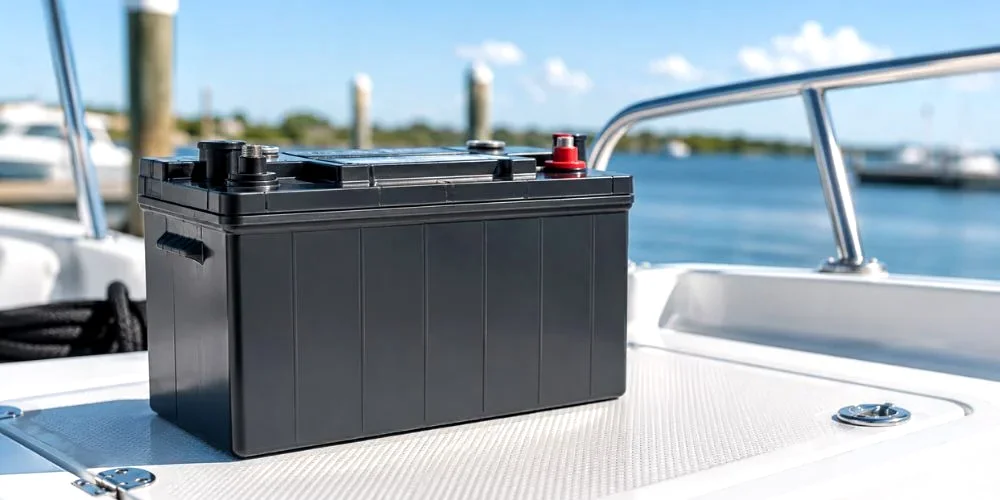
It is late October at a lake marina in Michigan. The pontoon is shrink-wrapped, the outboard is fogged and the fuel is stabilized, but the 12V battery that ran the trolling motor and fish finder all summer still sits in its tray with the switch turned off. In April it reads 11.9V and refuses to hold a charge. Nothing broke; the battery simply drained in the cold.
Storing a boat battery for winter comes down to four things: charge it correctly for its chemistry, disconnect every load, keep it somewhere cool and dry and check it on a schedule until spring.
Know the Battery Chemistry Before Storage
Most boats carry either a lead acid battery (flooded, AGM or gel) or a lithium iron phosphate (LiFePO4) pack. The label or datasheet lists the chemistry, nominal voltage and amp-hour rating, which together decide the storage plan. Many owners use the same deep cycle battery range for trolling motors and house loads, so one boat may hold two or three batteries that each need their own approach.
Lead acid batteries lose charge on their own while they sit. A flooded battery can drop several percent per month, with the rate rising in warmer conditions. LiFePO4 cells lose very little by themselves, although a battery management system (BMS), Bluetooth module or small connected load can still pull a pack down over a long layup.
Charge to the Right Level for Each Type
Lead acid batteries should go into storage fully charged. A rested 12V flooded or AGM battery at full charge typically reads about 12.6V to 12.8V. When a lead acid battery sits partly discharged, sulfate crystals harden on its plates, which is the main reason neglected batteries lose capacity over the off-season.
Charge level also protects against freezing. The electrolyte in a fully charged lead acid battery will not freeze until temperatures fall far below zero. A deeply discharged battery holds mostly water and can freeze not far below 32°F, cracking the case and buckling the plates.
Lithium follows different rules. Many LiFePO4 manufacturers recommend storing a pack at roughly 50% to 60% state of charge rather than 100%, which reduces stress on the cells over several months. The LiFePO4 battery options on the site each come with a datasheet listing their storage limits.
Disconnect or Remove the Battery Safely
Turning off the battery switch does not always isolate every circuit. Bilge pump float switches, stereo memory, carbon monoxide detectors and some chartplotters may be wired straight to the battery. Physically disconnecting the cables is the only reliable way to stop that draw. Boats that stay in the water are the exception, since an automatic bilge pump may need power; a maintainer or shore power charger should then keep the battery supported.
When removing a battery from the boat, a simple sequence keeps the job safe:
- Wear safety glasses and gloves. Remove rings or metal watch bands.
- Disconnect the negative cable first, then the positive cable.
- Label each cable or take a photo so the wiring goes back the same way.
- Lift the battery by its handles or a carrier strap and keep it upright.
- Tape the loose cable ends so they cannot touch metal in the boat.
Terminals often show white or green buildup by the end of a season. Removing it before storage stops the corrosion from spreading. The steps for cleaning corroded battery terminals apply equally to marine posts.
Pick a Cool and Dry Storage Spot
A cool, dry location above freezing suits almost every battery. An attached garage, basement or heated workshop works well. Heat speeds up self-discharge in lead acid batteries, so a spot beside a furnace or water heater is a poor choice.
Keep the battery away from flames, sparks and fuel cans. Flooded batteries release hydrogen while charging, so any area where they sit on a charger needs ventilation. The old warning about setting batteries on concrete dates back to early hard rubber cases; modern plastic cases are not drained by a concrete floor. A shelf or plastic tray still keeps the case clean and dry.
Maintain the Charge Through Winter
A smart battery maintainer is the easiest way to keep a lead acid battery healthy over the off-season. Unlike an old trickle charger that pushes constant current, a maintainer switches to a float or monitoring mode once the battery is full. Its profile must match the chemistry, because flooded, AGM and gel batteries use different voltage settings.
Without a maintainer, check the resting voltage every four to six weeks. Recharge any lead acid battery that falls to about 12.4V, roughly 75% charged. Flooded batteries also need their electrolyte checked; if it sits below the fill line, add distilled water after charging, never tap water.
LiFePO4 packs usually need only a voltage check every couple of months. Charging a lithium battery below 32°F (0°C) can damage the cells unless the pack has low temperature protection or built-in heating, so any top-up belongs in a space above freezing.
Bring It Back Into Service in Spring
Before the first trip, give each battery a full charge with the correct profile and let it rest for a few hours. A pre-season check confirms whether it held up; the process for testing a marine battery safely covers voltage and load checks.
Reconnect the positive cable first and the negative cable last, then tighten both terminals to the manufacturer’s specification. Loose connections create heat and voltage drop that can look like a weak battery once the trolling motor is under load.
Conclusion
A boat battery that is charged to the right level, fully disconnected and kept in a cool, dry place has a far better chance of starting the new season strong. Lead acid batteries need to stay full, while lithium packs prefer a partial charge and protection from cold charging. National Battery Supply offers marine batteries in both chemistries. Each battery’s manual should guide its storage settings.
FAQs
Can I leave my boat battery in the boat over winter?
Yes, if the cables are disconnected and the battery stays charged or remains on a maintainer. Batteries left connected in a cold boat are the ones most likely to drain, sulfate or freeze.
Should I take my boat battery home for the winter?
Removing it is often safer. A garage or basement makes monitoring voltage and keeping the battery above freezing much easier.
Is a trickle charger safe to use all winter?
A basic trickle charger without automatic shutoff can overcharge a battery over several months. A smart maintainer with a float mode is designed to stay connected for long periods.
How long can a boat battery sit without charging?
A fully charged lead acid battery in a cool spot can often go one to two months before needing a top-up. LiFePO4 batteries can usually sit longer, though a periodic voltage check is still sensible.
Does a frozen boat battery need to be replaced?
Usually yes. Freezing can crack the case or damage the plates. A battery that has frozen should not be charged or used until a qualified technician has inspected it.
Featured Posts
Request more information
National Battery Supply delivers dependable energy storage solutions tailored to commercial, industrial, and government applications. Our catalog ranges from custom battery manufacturing and UPS systems, portable power stations, to high-capacity solutions like whole-home battery energy storage systems (BESS) and scalable containerized energy storage units- engineered for reliability, flexibility, and rapid deployment.
We support critical infrastructure, telecom, data centers, healthcare, and remote operations with power systems built for performance in demanding environments. Whether it’s deep cycle batteries, lithium forklift replacements, OEM portable power kits, solar backups, and large-scale energy storage systems. We provide tailored solutions with short lead times, custom branding, and bulk pricing.
Our team also specializes in helping integrators, resellers, and developers source complete battery systems for residential microgrids, off-grid power stations, and industrial container setups. Whether you need to back up a home, energize a remote site, or manage facility-wide loads, we have the scalable energy storage options to match.
Contact us today to learn how our advanced power systems can reduce downtime, extend operational capacity, and support your long-term energy goals.

National Battery Supply is a reputable manufacturer specializing in custom battery solutions. With over 20 years of experience, we can manage all your power needs.
Batteries
Copyright 2026 © National Battery Supply | UEI: Z66VQCUPCGL3 CAGE: 9UK94