- UEI: Z66VQCUPCGL3 CAGE: 9UK94
- +1 844-539-2555
- Sales@NationalBatterySupply.com

How Long Can a Deep Cycle Battery Last?
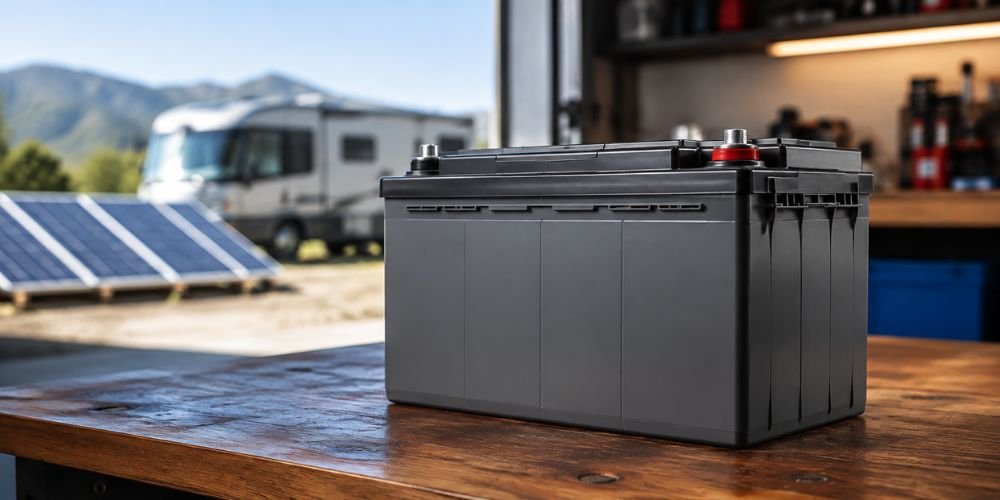
A deep cycle battery typically lasts 3 to 5 years for lead-acid batteries and around 8 to 10 years for lithium batteries when properly maintained. The actual lifespan depends on battery type, discharge depth, charging method, temperature, and usage conditions.
What Determines Deep Cycle Battery Life?
Deep cycle battery life is mainly determined by battery type, depth of discharge (DoD), charging habits, operating temperature, and maintenance.
What Does Battery Cycle Life Mean?
A cycle is not simply one day of use. It reflects energy taken out of the battery, then put back in. Several shallow discharges can add up to one full equivalent cycle.
Cycle ratings are tied to test conditions such as depth of discharge. A battery rated for thousands of cycles was not necessarily taken from full to empty each time. The percentage used during testing matters.
Which Deep Cycle Batteries Last Longer?
Different chemistries age in different ways. Lithium usually wins on cycle life. That does not make it right for every boat, RV or cart. The existing charger may not suit it. Cost matters too.
Why Does Depth of Discharge Important For Battery Life?
Depth of discharge (DoD) is important because the more energy a battery uses before recharging, the more stress it puts on the battery cells and the fewer charge cycles it can provide. For example, a lead-acid deep cycle battery discharged to 50% DoD may deliver around 500 to 800 cycles, while regularly discharging it to 80% to 100% DoD can reduce its cycle life significantly.
A few habits help:
- Recharge after use instead of leaving the battery low.
- Follow the maker’s recommended discharge limit.
- Use a charger built for the battery chemistry.
- Avoid storing the battery in excessive heat.
- Keep flooded batteries at the correct electrolyte level.
None takes much time. Problems build when the battery sits half charged for weeks or a flooded cell goes unchecked all summer.
Does Heat Shorten Battery Life?
Yes, heat can shorten battery life. High temperatures speed up the chemical reactions inside a battery, which causes the internal parts to wear out faster. A battery may appear to perform better in warm conditions because it can deliver more power temporarily, but continuous exposure to heat reduces its overall lifespan.
Can Better Charging Extend Battery Life?
Correct charging matters more than charging often.
Lead acid batteries do poorly when left partly discharged. Lithium batteries need settings that suit their chemistry. A charger made for another battery type can use the wrong voltage profile while still appearing to work normally.
Storage catches people out too. Alarms, controllers or other connected electronics can keep drawing power after the main equipment is switched off. A boat parked for three weeks can come back to a battery far lower than expected.
How Can a Weak Battery Be Spotted?
A weak deep cycle battery can be spotted when it loses charging capacity, shows a rapid voltage drop under load, charges unusually fast or slowly, and provides shorter runtime than before. A battery is generally considered weak when its usable capacity falls below 70% to 80% of its original rating.
Common warning signs include:
- Runtime dropping noticeably
- Voltage falling sharply under load
- Unusually slow or fast charging
- Swelling, leaking or excess heat
- Repeated low voltage shutdowns
A resting voltage reading can look normal even when usable capacity has fallen. The guide on battery testing explains why load behaviour matters alongside voltage.
A swollen, leaking or unusually hot battery should be taken out of service and assessed safely.
When Should You Replace The Battery?
You should replace a deep cycle battery when its capacity drops below 70% to 80% of its original rating, it cannot hold a charge, or it no longer provides enough runtime for the required load.
Conclusion
Deep cycle battery life is rarely about one dramatic mistake. It is usually shaped by ordinary use over months and years. Discharge depth, heat, charging and storage all leave a mark.
When replacement time comes, deep cycle batteries should be chosen around the real load, charging system and expected use rather than voltage alone. A battery that fits the job is more likely to give steady service than one chosen only because the label promises a big lifespan number.
Featured Posts
Request more information
National Battery Supply delivers dependable energy storage solutions tailored to commercial, industrial, and government applications. Our catalog ranges from custom battery manufacturing and UPS systems, portable power stations, to high-capacity solutions like whole-home battery energy storage systems (BESS) and scalable containerized energy storage units- engineered for reliability, flexibility, and rapid deployment.
We support critical infrastructure, telecom, data centers, healthcare, and remote operations with power systems built for performance in demanding environments. Whether it’s deep cycle batteries, lithium forklift replacements, OEM portable power kits, solar backups, and large-scale energy storage systems. We provide tailored solutions with short lead times, custom branding, and bulk pricing.
Our team also specializes in helping integrators, resellers, and developers source complete battery systems for residential microgrids, off-grid power stations, and industrial container setups. Whether you need to back up a home, energize a remote site, or manage facility-wide loads, we have the scalable energy storage options to match.
Contact us today to learn how our advanced power systems can reduce downtime, extend operational capacity, and support your long-term energy goals.

National Battery Supply is a reputable manufacturer specializing in custom battery solutions. With over 20 years of experience, we can manage all your power needs.
Batteries
Compliance
Copyright 2026 © National Battery Supply | UEI: Z66VQCUPCGL3 CAGE: 9UK94