- UEI: Z66VQCUPCGL3 CAGE: 9UK94
- +1 844-539-2555
- Sales@NationalBatterySupply.com
How to Recharge AA Batteries Safely?
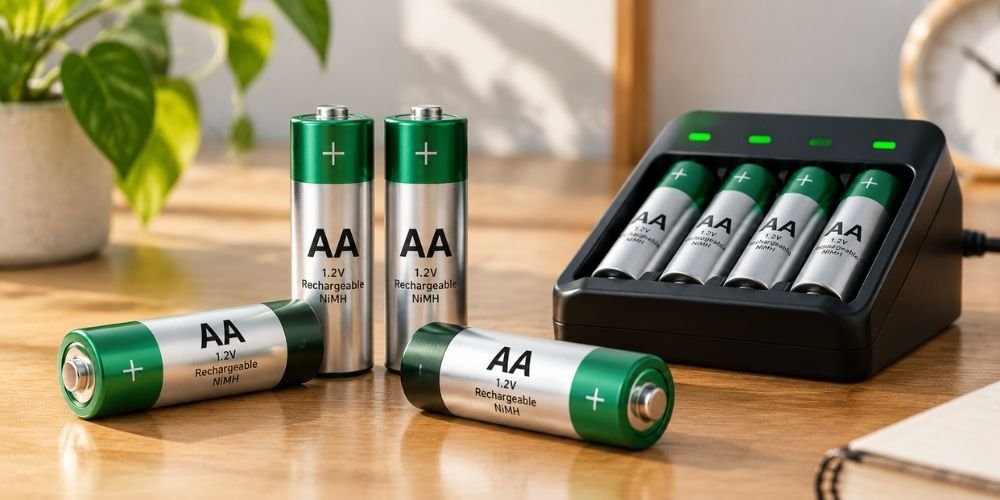
To recharge AA batteries, first use a charger that matches the AA battery chemistry. For the most common rechargeable AA type, NiMH, the battery is usually rated at 1.2V and around 1,900 to 2,500 mAh.
The safest and most common rechargeable AA batteries today are NiMH AA batteries, which usually have:
- Nominal voltage: 1.2V
- Capacity: Commonly around 1,200mAh to 2,500mAh depending on the battery model
- Charging method: Constant current charging using a NiMH-compatible charger
1. Confirm the Battery Type First
Before charging, check the label on the battery.
Safe to recharge:
NiMH (Nickel-Metal Hydride)
NiCd (Nickel-Cadmium)
Do not recharge:
Alkaline AA batteries
Carbon-zinc batteries
Disposable lithium AA batteries
Only use the charger specified for the battery chemistry. A NiMH charger should only be used for NiMH batteries.
2. Inspect the Batteries Before Charging
Before placing batteries into the charger, check for:
- Leakage
- Swelling
- Cracks
- Corrosion
- Damaged outer wrapping
Do not charge a damaged battery because it may become unsafe during charging.
3. Use a Proper NiMH Smart Charger
A smart charger is recommended because it monitors the charging process and stops or reduces charging when the battery reaches full capacity.
A good AA NiMH charger usually includes:
- Individual charging control for each battery
- Overcharge protection
- Temperature monitoring
- Automatic charge termination
Many smart chargers detect when the battery reaches full charge using methods such as negative delta voltage (-ΔV) detection and temperature monitoring.
4. Insert Batteries Correctly
Follow these steps:
- Match the positive (+) and negative (-) markings on the battery with the charger slots.
- Insert batteries firmly into the charger.
- Do not force batteries into the wrong position.
- Make sure the charger contacts are clean.
Incorrect polarity can prevent charging or damage the charger.
5. Charge Using the Correct Current
Charging current depends on the battery capacity.
A common safe charging range for AA NiMH batteries is around:
0.1C to 0.5C charging rate
Example:
For a:
2000mAh AA NiMH battery
A moderate charging current would be:
- 0.1C = 200mA
- 0.5C = 1000mA
A slower charge:
200mA to 300mA
may take longer but produces less heat.
A faster charge:
700mA to 1000mA
can reduce charging time but requires a proper smart charger with temperature and charge detection.
6. Monitor Charging Time
Charging time depends on battery capacity and charger output.
The basic calculation is:
Charging Time = Battery Capacity (mAh) ÷ Charger Current (mA) × 1.2
The extra 1.2 factor accounts for charging losses.
Example:
Battery:
2000mAh
Charger:
500mA
Calculation:
2000 ÷ 500 × 1.2
= 4.8 hours
So the battery may take approximately 5 hours to fully charge.
7. Avoid Overcharging
Leaving batteries on charge continuously with a basic charger can reduce battery life and increase heat.
Signs of overcharging include:
- Battery becoming very hot
- Battery swelling
- Reduced runtime after charging
A smart charger prevents this by reducing or stopping the charging current when the battery is full.
8. Charge Batteries at a Safe Temperature
Recommended charging environment:
- Room temperature: around 10°C to 30°C (50°F to 86°F)
Avoid charging:
- In direct sunlight
- Near heat sources
- In extremely cold conditions
High temperatures can shorten battery life and increase safety risks.
9. Charge Batteries Together When Possible
For devices that use multiple AA batteries:
- Use batteries with the same brand.
- Use batteries with the same capacity rating.
- Charge them together as a set.
Example:
If a flashlight uses four AA batteries:
Use four matching 2000mAh NiMH batteries instead of mixing:
- 1000mAh battery
- 2500mAh battery
- Different brands
Mixed batteries can discharge unevenly and reduce performance.
Conclusion
Rechargeable AA batteries can provide dependable power when the correct battery type, charger and storage methods are used. Understanding basic charging requirements helps prevent avoidable problems while supporting longer battery performance.
National Battery Supply offers rechargeable usb options for different applications, including rechargeable USB batteries designed for repeated use.
Featured Posts
Request more information
National Battery Supply delivers dependable energy storage solutions tailored to commercial, industrial, and government applications. Our catalog ranges from custom battery manufacturing and UPS systems, portable power stations, to high-capacity solutions like whole-home battery energy storage systems (BESS) and scalable containerized energy storage units- engineered for reliability, flexibility, and rapid deployment.
We support critical infrastructure, telecom, data centers, healthcare, and remote operations with power systems built for performance in demanding environments. Whether it’s deep cycle batteries, lithium forklift replacements, OEM portable power kits, solar backups, and large-scale energy storage systems. We provide tailored solutions with short lead times, custom branding, and bulk pricing.
Our team also specializes in helping integrators, resellers, and developers source complete battery systems for residential microgrids, off-grid power stations, and industrial container setups. Whether you need to back up a home, energize a remote site, or manage facility-wide loads, we have the scalable energy storage options to match.
Contact us today to learn how our advanced power systems can reduce downtime, extend operational capacity, and support your long-term energy goals.
National Battery Supply is a reputable manufacturer specializing in custom battery solutions. With over 20 years of experience, we can manage all your power needs.
Batteries
Copyright 2026 © National Battery Supply | UEI: Z66VQCUPCGL3 CAGE: 9UK94