- UEI: Z66VQCUPCGL3 CAGE: 9UK94
- +1 844-539-2555
- Sales@NationalBatterySupply.com
Can a Deep Cycle Battery Start an Engine?
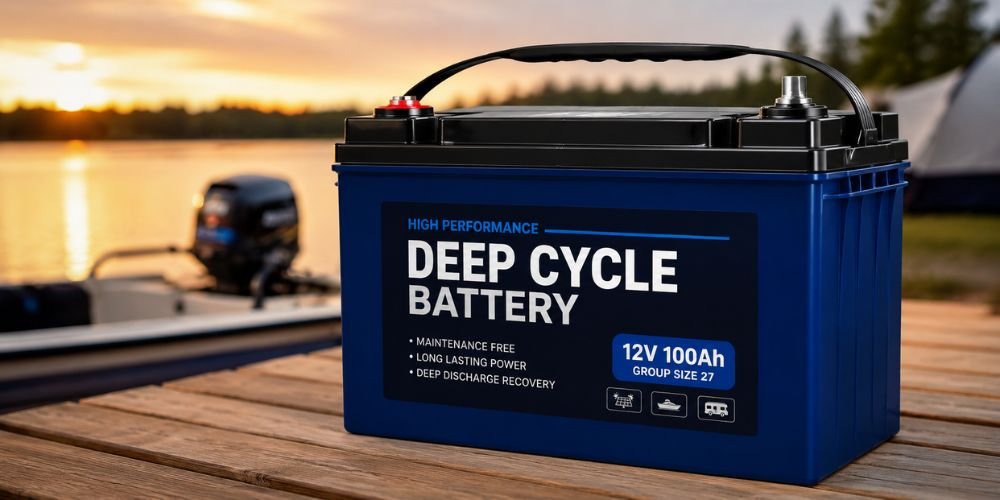
Yes, a deep cycle battery can start an engine if it has enough starting current (CCA), but most deep cycle batteries are not designed for engine starting because they cannot deliver the high current needed by starter motors.
Why Deep Cycle Batteries Are Not Made for Engine Starting?
Deep cycle batteries are not made for engine starting because they are designed to deliver lower current over a long period, while a starter motor needs a very high current for a few seconds.
Deep cycle batteries usually use fewer, thicker plates. That design helps them handle repeated deep discharges, such as powering lights, trolling motors, RV equipment, or solar systems, but it also means they usually have lower cranking performance for the same battery size.
What Happens If You Use a Deep Cycle Battery to Start an Engine?
If you use a deep cycle battery to start an engine, it may crank the engine if the battery can supply enough current, but repeated starting can shorten the battery’s life.
What usually happens is:
- The engine may start normally if the battery has enough CCA or MCA.
- Voltage may drop more under cranking than with a proper starting battery.
- The battery can heat up more because of the high current draw.
- Repeated cranking can speed up plate wear and reduce cycle life.
- If the battery cannot provide enough current, the starter may turn slowly, click, or fail to crank the engine.
When Can a Deep Cycle Battery Be Used as a Starting Battery?
A deep cycle battery can be used as a starting battery only if it can safely supply the engine’s required cranking current and its voltage matches the starting system.
It is suitable when:
- The battery has a published CCA or MCA rating that meets or exceeds the engine manufacturer’s minimum requirement.
- The battery is a dual-purpose deep cycle/starting battery, which is designed for both cranking and repeated discharge.
- The system voltage matches, such as a 12V battery for a 12V starter system.
- For lithium batteries, the BMS peak-discharge rating is high enough for starter current. For example, if the starter can pull 400A, the BMS must support at least that current for the required cranking time.
- It is being used for occasional or emergency starting, not continuous daily cranking, unless the battery is specifically rated for starting duty.
How to Check If a Deep Cycle Battery Can Start Your Engine?
To check if a deep cycle battery can start your engine, compare the battery’s cranking rating with the engine’s required starting current, then verify the battery can hold voltage while cranking.
First, check the battery label for CCA (Cold Cranking Amps) or MCA (Marine Cranking Amps). The battery’s rating should meet or exceed the minimum specified by the vehicle or engine manufacturer.
Then fully charge the battery and measure its resting voltage. A healthy 12V lead-acid battery should read about 12.6–12.8V at rest.
Next, connect the battery and crank the engine while watching the voltage with a multimeter. On a 12V lead-acid system, the voltage should generally stay above about 9.6V during cranking at around 21°C (70°F). If it drops well below this level, the battery may be too weak, too small, or unable to supply enough starting current.
Also check the starter performance. If the engine cranks at normal speed and the voltage stays within range, the battery can likely handle starting. If the starter turns slowly, clicks, or the voltage collapses quickly, the battery is not suitable for reliable engine starting.
Can Starting an Engine Damage a Deep Cycle Battery?
Yes, starting an engine can damage a deep cycle battery if the battery is not made for high-current cranking or if it is used this way repeatedly.
The main risk is internal plate stress and heat buildup. A deep cycle battery uses thicker plates made for long, steady discharge. Engine starting pulls a large current in a few seconds, which can cause faster plate shedding, higher internal temperature, and earlier capacity loss.
An occasional start usually will not damage a healthy battery if it has enough cranking capability, but repeated use can shorten its life. The risk is higher when the battery is partly discharged, undersized for the engine, or forced to crank for long periods.
For a 12V lead-acid battery, avoid repeated cranking if the voltage falls below about 9.6V during starting at around 21°C (70°F). If the battery has no CCA or MCA rating, it should not be used as a regular starting battery.
How Long Can a Deep Cycle Battery Be Used for Starting?
A deep cycle battery should only be used for short starting attempts, typically about 5–10 seconds at a time, unless the battery manufacturer gives a specific cranking limit.
After each attempt, allow about 30–60 seconds for the battery and starter to cool before trying again. Avoid continuous cranking for 15–30 seconds or more, because the high current can quickly heat the battery, cables, and starter motor.
For repeated starting use, the battery should have a stated CCA or MCA rating. If it does not, it is better treated as an emergency starting source rather than a regular starter battery.
If the engine needs several long cranking attempts to start, stop and check the fuel, ignition, starter, or battery condition instead of continuing to crank.
Featured Posts
Request more information
National Battery Supply delivers dependable energy storage solutions tailored to commercial, industrial, and government applications. Our catalog ranges from custom battery manufacturing and UPS systems, portable power stations, to high-capacity solutions like whole-home battery energy storage systems (BESS) and scalable containerized energy storage units- engineered for reliability, flexibility, and rapid deployment.
We support critical infrastructure, telecom, data centers, healthcare, and remote operations with power systems built for performance in demanding environments. Whether it’s deep cycle batteries, lithium forklift replacements, OEM portable power kits, solar backups, and large-scale energy storage systems. We provide tailored solutions with short lead times, custom branding, and bulk pricing.
Our team also specializes in helping integrators, resellers, and developers source complete battery systems for residential microgrids, off-grid power stations, and industrial container setups. Whether you need to back up a home, energize a remote site, or manage facility-wide loads, we have the scalable energy storage options to match.
Contact us today to learn how our advanced power systems can reduce downtime, extend operational capacity, and support your long-term energy goals.
National Battery Supply is a reputable manufacturer specializing in custom battery solutions. With over 20 years of experience, we can manage all your power needs.
Batteries
Copyright 2026 © National Battery Supply | UEI: Z66VQCUPCGL3 CAGE: 9UK94