- UEI: Z66VQCUPCGL3 CAGE: 9UK94
- +1 844-539-2555
- Sales@NationalBatterySupply.com

How to Test Golf Cart Batteries?
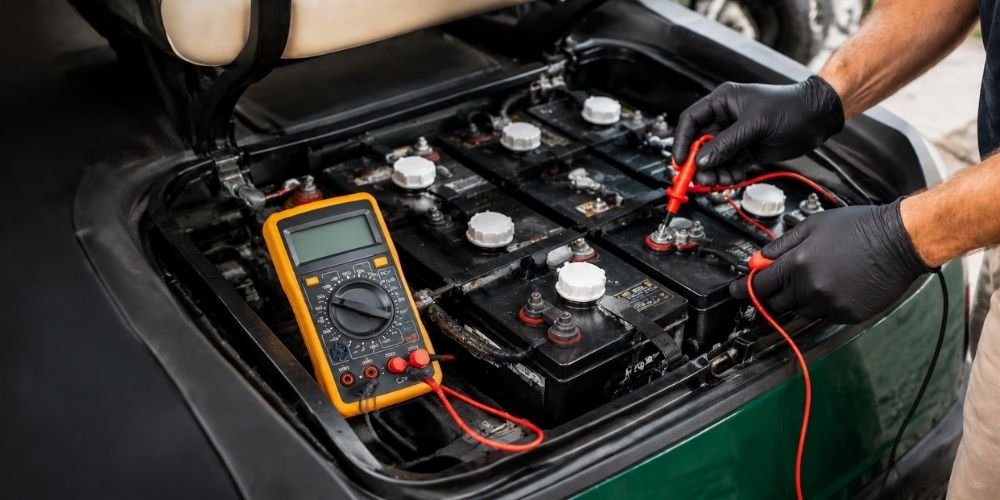
To test golf cart batteries, measure the DC voltage of each battery with a digital multimeter, inspect terminals and cables for corrosion or loose connections, then perform a load test or specific gravity test to check battery condition.
Check the Battery Before Testing
The battery compartment deserves a look before any meter comes out. Cracked cases, swelling, leaking fluid, melted posts or unusual heat are reasons to stop. A damaged battery should be assessed by a qualified technician.
A loose cable or crusted terminal can also mislead. The cart may hesitate under load even though the battery still has usable capacity. Connections should be checked before the battery is blamed.
Protective glasses and gloves are sensible around flooded lead acid batteries. Metal jewellery should stay away from exposed terminals. A wrench or meter probe must never bridge positive and negative posts.
Confirm What Battery Type Is Installed
The label usually settles the next question. Traditional carts may use 6V, 8V or 12V batteries wired together. Lithium carts may use one larger pack with an internal battery management system.
Flooded batteries have removable caps and liquid electrolyte. AGM batteries are sealed. Lithium packs are sealed too. A hydrometer belongs only on a serviceable flooded battery.
Golf carts commonly use batteries built for repeated discharge. The Deep Cycle Batteries section explains how that duty differs from a normal starting battery.
Charge It Before Taking a Reading
A partly charged battery can look worn out when it is simply low. Testing should begin after a full charge using a charger approved for the installed battery type.
Lead acid voltage needs time to settle after charging. Surface charge can leave the reading temporarily high, making a tired battery look healthier than it is. Rest time varies by manufacturer. A longer rest with the charger disconnected gives a cleaner open-circuit reading.
National Battery Supply’s guide on testing a deep cycle battery explains the same principle across other deep cycle applications.
Check Each Battery With a Multimeter
A digital multimeter should be set to DC volts. Each battery in a multi-battery pack should be checked separately. The red probe goes to positive. The black probe goes to negative.
A fully charged flooded lead acid battery may rest near 6.4V for a 6V unit, around 8.6V for an 8V unit or roughly 12.7 to 12.8V for a 12V unit. These are reference figures, not universal pass marks. Temperature and manufacturer specifications can shift the expected result.
The useful clue is often the difference between batteries. If five sit close together while one reads noticeably lower after the same charge and rest period, that battery deserves more attention.
Resting voltage mainly shows charge level. It does not prove how much useful capacity remains.
See What Happens Under Load
That difference shows up under load. A weak battery may look fine with the cart parked, then its voltage drops hard when the motor asks for current. The driver may notice sluggish acceleration, shorter range or poor hill performance.
A proper load or capacity test puts controlled demand on the battery. The equipment must match the chemistry and rating. An automotive cranking test should not automatically be used for every golf cart battery because deep cycle batteries are built for sustained output rather than a short starting burst.
Use a Hydrometer on Flooded Batteries
For a flooded lead acid battery, a hydrometer adds another clue. It measures the specific gravity of electrolyte in each cell after charging. Readings should be compared with the battery manufacturer’s chart.
One cell sitting well below the others can point toward imbalance or internal trouble. AGM, gel and lithium batteries should never be opened for this test.
Watch How the Cart Behaves
Battery behaviour during use still counts. A cart that once finished a familiar route but now needs charging much earlier is showing practical evidence of lost capacity. Tire pressure, added weight and terrain can affect range too, so one odd trip should not settle the diagnosis.
The golf cart battery maintenance checklist covers terminal condition, charging behaviour, flooded battery water levels and changes in driving range.
Lithium Batteries Need Different Clues
Lithium batteries need a slightly different reading. Their voltage can stay fairly steady through much of a discharge cycle, so a basic multimeter may reveal less about remaining capacity than with lead acid.
Battery management system data can help. A manufacturer-approved capacity test can help too. Repeated low-range performance or unexpected BMS shutdowns after a full charge deserve investigation.
Read Several Signs Together
One poor reading should not trigger immediate replacement. A weak charger, dirty connection, loose cable or incomplete charge can imitate battery failure.
A stronger case appears when several signs line up. Resting voltage stays low after correct charging. One flooded cell remains far below the others. Voltage collapses under a suitable load. Driving range keeps shrinking.
High-voltage lithium packs, damaged batteries or systems with uncertain wiring are better left to a battery technician. Improvised short-circuit tests are dangerous.
Conclusion
A sound test combines physical condition, charge state, individual battery voltage and behaviour under demand. Flooded batteries can add specific gravity. Lithium packs often rely more on BMS information and measured capacity.
When results consistently show lost usable capacity, replacement Golf Cart Batteries should match the cart voltage, battery chemistry, charger and installation requirements. Replacing a battery after one quick low reading can miss the real fault.
Featured Posts
Request more information
National Battery Supply delivers dependable energy storage solutions tailored to commercial, industrial, and government applications. Our catalog ranges from custom battery manufacturing and UPS systems, portable power stations, to high-capacity solutions like whole-home battery energy storage systems (BESS) and scalable containerized energy storage units- engineered for reliability, flexibility, and rapid deployment.
We support critical infrastructure, telecom, data centers, healthcare, and remote operations with power systems built for performance in demanding environments. Whether it’s deep cycle batteries, lithium forklift replacements, OEM portable power kits, solar backups, and large-scale energy storage systems. We provide tailored solutions with short lead times, custom branding, and bulk pricing.
Our team also specializes in helping integrators, resellers, and developers source complete battery systems for residential microgrids, off-grid power stations, and industrial container setups. Whether you need to back up a home, energize a remote site, or manage facility-wide loads, we have the scalable energy storage options to match.
Contact us today to learn how our advanced power systems can reduce downtime, extend operational capacity, and support your long-term energy goals.

National Battery Supply is a reputable manufacturer specializing in custom battery solutions. With over 20 years of experience, we can manage all your power needs.
Batteries
Compliance
Copyright 2026 © National Battery Supply | UEI: Z66VQCUPCGL3 CAGE: 9UK94