- UEI: Z66VQCUPCGL3 CAGE: 9UK94
- +1 844-539-2555
- Sales@NationalBatterySupply.com
How to Charge a Deep Cycle Battery Safely?
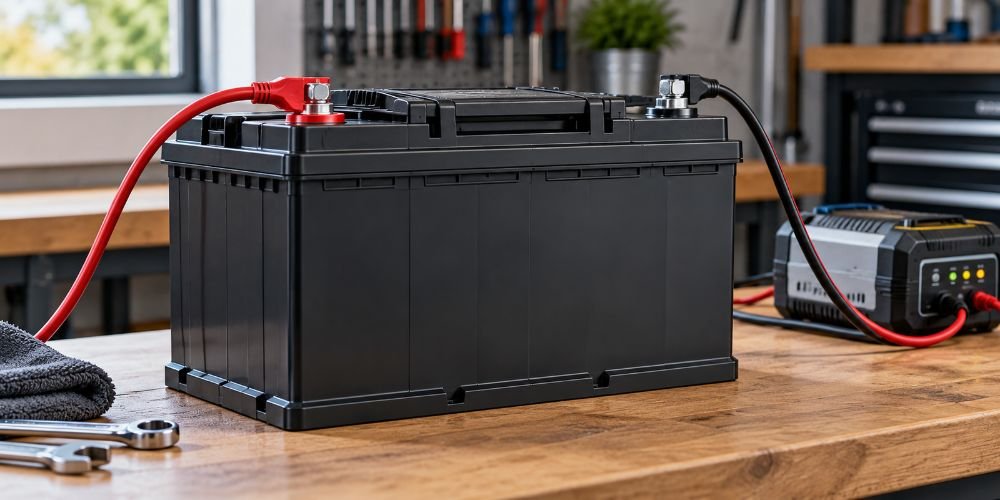
RV lights keep on but the water pump slows down at 6pm. Everything was charged all afternoon. There is no doubt that something did not work, but it would be easy to blame the battery right away. It could be a bad connection or a charger that doesn’t work right.
For readers comparing equipment at National Battery Supply, learning how to charge a deep cycle battery begins with its label. The chemistry matters as much as the voltage printed beside it.
Find Out What Battery Is Installed
A deep cycle battery might be flooded with lead acid, AGM, gel or lithium iron phosphate (LiFePO4). They are all designed to provide power over time but their power needs are different. A 12V charger is not always suited for every 12V battery.
Flooded batteries have cells that are serviced with liquid electrolyte. Both AGM and gel type are sealed Lead acid designs. LiFePO4 batteries usually have an electronic battery management system (BMS) fitted, to prevent damaging charging scenarios.
The chemistry, nominal voltage, capacity in amp-hours (Ah) and permitted charging current should be stated on the label or in the manufacturer’s documentation. If the label is absent, don’t try to guess from the case form. You may want to check with an installation or battery specialist to identify it.
Choose the Right Charger
A modern smart charger may have several profiles for flooded, AGM, gel and li-ion. Choose the wrong one and you’ll have a battery that is undercharged or above its rated voltage. AGM, gel or LiFePO4 do not employ a lead acid repair or equalization mode unless the manufacturer explicitly approves the particular technique.
The LiFePO4 Batteries line demonstrates why lithium should be its own category. Its BMS is a protector, not a license to drop any old charger in. The site’s post on charging a LiFePO4 battery has further details about the specific profile.
Charging current is important too. For example, a 10A charger replacing 50Ah would require more than five hours, if the slower finishing stage and losses are taken into account. Faster is not always better. The handbook defines the limit current as safe.
Securely Make the Connections
Before plugging in a portable charger, it is worth checking the battery and wires. If the case is broken , electrolyte leaking , housing bloated or terminal burned it needs expert examination not to be charged again.
A replaceable battery normally follows a simple sequence:
- Switch off any power consuming devices and follow the charger’s isolation recommendations.
- Store the charger in a dry area with good ventilation. Lead acid batteries: Keep away from sparks and fires.
- With the charger unplugged, connect the positive lead of the charger to the positive terminal and the negative lead of the charger to the terminal indicated in the manuals of the charger and equipment.
- Choose the battery profile. Verify the charging limitations before turning on the charger.
- Allow the automated cycle to complete. Before removing the leads, switch off or disconnect the mains power in the sequence given in the instructions.
An installed RV or marine battery could have a permanently connected charging system. Instructions for portable clamps superseded by authorized connection technique. High-voltage banks need competent handling.
Understand the Meaning of the Stages of Charging
Lead acid batteries usually start with bulk charging in smart chargers, where the current performs most of the work. Absorption: current decreases slowly when voltage is held. Then a proper float stage can keep the battery topped up without constant heavy charging.
Lithium charging generally has a distinct profile, frequently with a bulk and absorption phase that is regulated in conjunction with the BMS. It should not be put through a lead acid de-sulfation cycle. You can’t just hook up a panel to a solar system without having a charge controller set up for the chemistry you have installed.
The cold weather also modifies the strategy. Some LiFePO4 devices will not allow charging below freezing unless they have a certified heating or low temperature protection mechanism. Each battery has different precise limitations.
How Long Does A Charge Take?
A battery’s Ah rating is a start, not a stopwatch. A 100Ah battery with 50Ah taken out of it would seem to require five hours on a 10A charger. Actually charging slows as you approach full capacity and there is energy wasted along the route.
This is influenced by factors such as age, temperature, the power of the charger and any other loads attached. A poor charger on a busy RV electrical system could just keep up with what the fridge is pulling.
If a charger is hot or smells funny, don’t use it until you’ve had it checked out, then plug it in again.
A completed charge indication is informative but not a determinant of battery health. The guide to assessing a deep cycle battery shows why resting voltage alone can’t determine useful capacity as runtimes continue to reduce.
Small Habits That Keep You Out of Trouble
Lead acid batteries should not be habitually left uncharged. Flooded cells also need frequent electrolyte monitoring. After charging, generally add distilled water. If plates are exposed before charging, add just enough water to cover the plates before charging. Do not open AGM and gel cases for watering.
Corroded terminals, loose connections and overheated cables should be taken care of before your next journey. For certain flooded batteries, equalization is a regulated process, it’s not a blanket repair for every battery that looks worn.
Another warning is a BMS shutdown. Not an invitation to evade the safeguards. It may be a temperature issue or low voltage or a charging malfunction. If the system keeps shutting down , it needs to be checked , not forced into another cycle.
Conclusion
A reliable charge starts with knowing the battery chemistry and using the correct charger. Clean connections, safe temperatures and a complete charging cycle matter more than rushing the process. The Deep Cycle Batteries range covers different power needs, but each pack’s own instructions should decide the charging settings.
Featured Posts
Request more information
National Battery Supply delivers dependable energy storage solutions tailored to commercial, industrial, and government applications. Our catalog ranges from custom battery manufacturing and UPS systems, portable power stations, to high-capacity solutions like whole-home battery energy storage systems (BESS) and scalable containerized energy storage units- engineered for reliability, flexibility, and rapid deployment.
We support critical infrastructure, telecom, data centers, healthcare, and remote operations with power systems built for performance in demanding environments. Whether it’s deep cycle batteries, lithium forklift replacements, OEM portable power kits, solar backups, and large-scale energy storage systems. We provide tailored solutions with short lead times, custom branding, and bulk pricing.
Our team also specializes in helping integrators, resellers, and developers source complete battery systems for residential microgrids, off-grid power stations, and industrial container setups. Whether you need to back up a home, energize a remote site, or manage facility-wide loads, we have the scalable energy storage options to match.
Contact us today to learn how our advanced power systems can reduce downtime, extend operational capacity, and support your long-term energy goals.

National Battery Supply is a reputable manufacturer specializing in custom battery solutions. With over 20 years of experience, we can manage all your power needs.
Batteries
Copyright 2026 © National Battery Supply | UEI: Z66VQCUPCGL3 CAGE: 9UK94