- UEI: Z66VQCUPCGL3 CAGE: 9UK94
- +1 844-539-2555
- Sales@NationalBatterySupply.com

How to Connect a Power Inverter to a Car Battery?
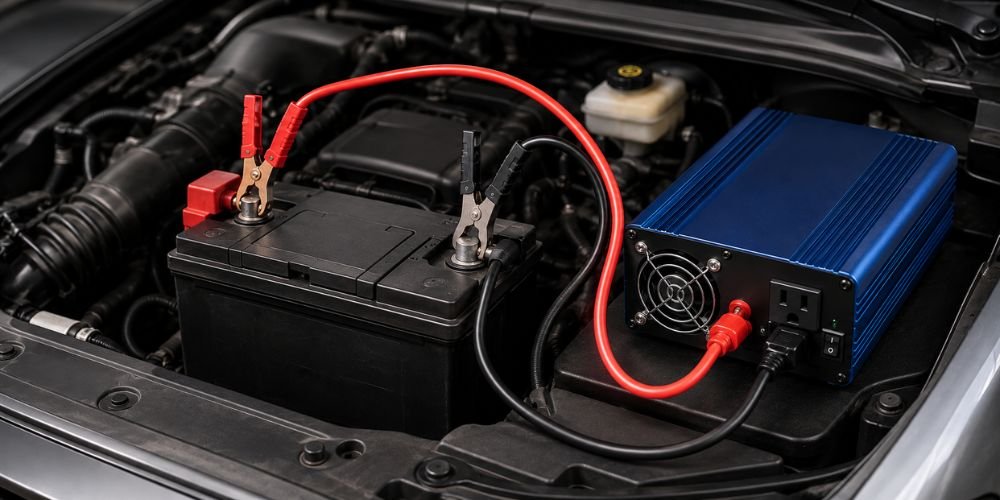
To connect a power inverter to a car battery, connect small inverters (around 100W to 150W) to the vehicle’s 12V accessory socket if the socket rating supports the load. For larger inverters, connect directly to the battery terminals using correctly sized cables and an inline fuse because they can draw high current that the cigarette lighter socket cannot handle.
Can an Inverter Plug Into a 12V Socket?
Yes, a small power inverter can plug into a 12V car socket, also known as a cigarette lighter socket or accessory socket, but only if the inverter’s power rating stays within the socket’s current limit. These sockets are designed for low to medium power devices, not high-power inverters.
Most vehicle 12V sockets are connected to a fuse and are usually rated between 10 amps and 20 amps, depending on the vehicle model.
What Needs Checking Before Connection?
The inverter should be off before any cable is attached. Its input voltage also needs to match the vehicle battery.
Heavy corrosion, swelling, leaking fluid or damaged terminals need attention before anything is connected.
A few basics should be ready:
- Correct positive and negative cables
- Cable size recommended by the inverter maker
- The right fuse for the positive lead
- Clean battery terminals
- A dry place with room for airflow
Cable thickness should not be guessed. A cable that looks heavy can still be too small under load. Long cable runs can make that problem worse.
Where Does the Fuse Go?
The fuse normally sits in the positive cable close to the battery. It protects the cable if something shorts between the battery and inverter.
The rating should come from the inverter instructions. Going larger just to stop a fuse from blowing is not a fix. It can leave the wiring carrying more current than it was meant to handle.
How Are the Cables Connected?
The cables of a power inverter connected to a battery must be connected in the correct order to safely transfer power from the battery to the inverter. A typical 12V inverter system uses two main cables: a positive (+) cable and a negative (-) cable. The positive cable carries power from the battery to the inverter, while the negative cable completes the electrical circuit back to the battery.
For safety, the positive cable should always include a fuse or circuit breaker close to the battery terminal. This protects the cable and battery from damage if a short circuit occurs.
Where Should the Inverter Be Mounted?
An inverter needs airflow. The back corner of a packed trunk may be convenient but it can hold heat around the unit.
The mounting area should stay dry and reasonably cool. It should also be away from moving parts, road spray and places where luggage can cover the vents.
Shorter battery cables are usually easier to manage because long DC runs increase voltage drop. That does not mean the inverter should be squeezed beside the battery in an unsafe spot.
Can a Car Battery Run an Inverter for Hours?
Yes, a car battery can run an inverter for around 1 to 10 hours, A typical 12V 60Ah–70Ah car battery may run small devices like LED lights or routers for several hours, while higher-power devices such as laptops, monitors, or appliances will drain the battery much faster. A standard car battery is designed mainly to provide a short burst of high current to start the engine, not for long periods of continuous power use.
A car battery is mainly built to deliver a strong burst of current when the engine starts. It is not meant to be drained deeply again and again. A long evening of powering equipment can leave too little energy to crank the engine later.
The article on deep discharge explains why repeated heavy discharge can shorten battery life.
For regular camping, work equipment or longer backup use, a separate auxiliary battery may be a better fit. Off Grid Inverters are more relevant once the setup moves beyond occasional power from a starter battery.
Why Does the Inverter Keep Beeping?
An inverter keeps beeping because it is usually warning about a power, battery, temperature, or connection problem. The beep is a safety alert that tells you the inverter is detecting an issue and may shut down to protect itself or the connected devices.
A few signs should stop further testing:
- Hot cables or terminals
- A burning smell
- Melted insulation
- Repeated fuse failures
- Shutdowns with moderate loads
If the problem only appears when a heavier appliance starts, the load and startup surge deserve another look before the wiring is changed.
When Is Professional Help the Better Call?
Portable units with factory supplied clamps are usually straightforward. Permanent high power installations are not.
A fixed setup may involve chassis grounding, alternator capacity, cable routing through body panels or permanent AC outlets. Those details can be easy to miss during a driveway installation.
Professional help also makes sense when the same fuse keeps blowing or a cable keeps heating up after the obvious checks have been made.
Conclusion
A dependable inverter setup is rarely about one clever trick. It comes down to matching the voltage, using the right cable, protecting the positive lead and keeping every terminal tight.
Power Inverter Stations can be useful when a separate power setup makes more sense than repeatedly drawing from a starter battery. The practical test is simple: the system should run the intended load without hot cables, repeated alarms or a car that will not start afterward.
Featured Posts
Request more information
National Battery Supply delivers dependable energy storage solutions tailored to commercial, industrial, and government applications. Our catalog ranges from custom battery manufacturing and UPS systems, portable power stations, to high-capacity solutions like whole-home battery energy storage systems (BESS) and scalable containerized energy storage units- engineered for reliability, flexibility, and rapid deployment.
We support critical infrastructure, telecom, data centers, healthcare, and remote operations with power systems built for performance in demanding environments. Whether it’s deep cycle batteries, lithium forklift replacements, OEM portable power kits, solar backups, and large-scale energy storage systems. We provide tailored solutions with short lead times, custom branding, and bulk pricing.
Our team also specializes in helping integrators, resellers, and developers source complete battery systems for residential microgrids, off-grid power stations, and industrial container setups. Whether you need to back up a home, energize a remote site, or manage facility-wide loads, we have the scalable energy storage options to match.
Contact us today to learn how our advanced power systems can reduce downtime, extend operational capacity, and support your long-term energy goals.
National Battery Supply is a reputable manufacturer specializing in custom battery solutions. With over 20 years of experience, we can manage all your power needs.
Batteries
Compliance
Copyright 2026 © National Battery Supply | UEI: Z66VQCUPCGL3 CAGE: 9UK94