- UEI: Z66VQCUPCGL3 CAGE: 9UK94
- +1 844-539-2555
- Sales@NationalBatterySupply.com

Why an RV Battery Won’t Hold a Charge After a Trip?
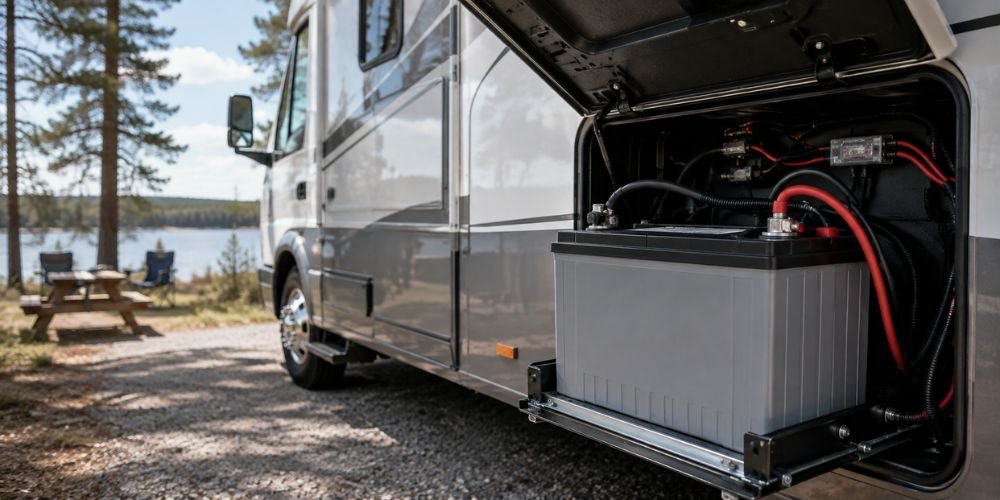
An RV battery usually will not hold a charge after a trip because of deep discharge, battery age, sulfation, incorrect charging, parasitic loads, or a failing charging system. The fastest way to identify the issue is to check the resting voltage, charging voltage, and battery capacity.
National Battery Supply carries batteries for different applications, so diagnosis should begin with the battery type already fitted to the vehicle.
The Trip May Have Ended With a Partial Charge
A long drive home can make it seem as though the house battery has been fully recharged. Not always.
Alternator charging may be limited by cable size, voltage drop, an isolator, or the vehicle’s charging controls. Solar panels may have spent part of the trip shaded. A converter can also stop short of a full charge if its settings do not suit the battery chemistry.
The RV then gets parked with the battery already partway down. After a few quiet days, the loss looks sudden.
Lead-acid batteries suffer when they sit partly discharged. Repeated deep cycling can also reduce usable capacity. National Battery Supply explains the issue in its guide to deep discharge and battery life, which can help when a battery appears to recover after charging but drains much faster than it once did.
Small Loads Can Keep Pulling Power
An RV that looks switched off may still be using electricity.
Propane detectors, stereo memory, tank monitors, control boards and inverter standby circuits can stay active. Aftermarket alarms or trackers may add more. None looks serious by itself. Left connected for several days, the combined draw can flatten a tired battery.
A battery disconnect helps only if it separates the circuits creating the drain. Some safety equipment may remain powered even with the main switch off.
A useful clue appears when the battery is isolated from the RV. If it holds charge while disconnected but drops quickly after reconnection, the fault may sit somewhere in the vehicle rather than inside the battery.
The company’s Recreational Vehicle Batteries page gives context for batteries handling repeated camping loads instead of short engine starting bursts.
The Charger Can Be the Real Problem
Sometimes the battery gets blamed because it is showing the symptom.
The actual fault may be upstream. A loose terminal, blown fuse, poor ground or failing converter can prevent a complete charge. A charger may still appear active even though the battery never reaches a proper full state.
Chemistry changes create another trap. A charger set for flooded lead acid may not suit a lithium bank. The same compatibility issue can involve solar controllers and alternator charging equipment.
That is why replacement should not happen before the charging path is checked. Deep Cycle Battery Supply and Manufacture gives useful background on batteries made for repeated discharge cycles. That distinction matters in an RV because house loads behave very differently from an engine starter.
Heat, Cold and Age Change Battery Behavior
A battery can leave on a trip healthy enough and return noticeably weaker.
Heat speeds battery aging. Rough roads can loosen a connection that seemed fine before departure. Flooded batteries can lose electrolyte over time. An older battery may even show a normal resting voltage, then fall sharply when lights, pumps or an inverter begin pulling current.
old creates a different problem for lithium batteries. Many LiFePO4 systems use a battery management system that restricts charging when cell temperature becomes too low. The charger may be operating while the battery temporarily refuses the charge for protection.
Those signs do not prove battery failure. They narrow the search.
A Few Checks Usually Expose the Fault
Battery chemistry and rated voltage should be confirmed first. Connections should then be checked for corrosion, loose hardware, damaged lugs or signs of overheating.
Next comes a full charge with the correct charger. A resting voltage check can help with lead acid batteries, but voltage alone does not reveal how much usable capacity remains. A load test gives a better picture because it shows what happens when the battery is asked to work.
National Battery Supply’s guide to testing a deep cycle battery explains that difference in practical terms. A battery can look charged while having little useful capacity left under load.
If the battery tests well, attention should move back to the RV. Converter output, solar charging, alternator charging and parasitic current can then be checked separately. That approach beats replacing parts on a guess.
Replacement Should Follow Evidence
Replacement makes sense when a fully charged battery repeatedly fails a proper load test, shows physical damage or has lost enough capacity to make normal RV use impractical.
The replacement still needs to match the electrical system. Voltage, chemistry, charging equipment and expected demand all matter. A lithium battery can offer more usable capacity, but it is not automatically compatible with every existing converter or inverter.
A larger battery cannot repair a charging fault. It may only hide the same fault for longer.
Conclusion
An RV battery that loses charge after a trip may be worn out, but several other faults can create the same symptom. Checking charge level, hidden loads and charger performance first can prevent an unnecessary replacement.
For RV or off grid systems built specifically around a 48V class battery bank, the 51.2V 100Ah LiFePO4 Battery Pack is one available option. Its voltage and charging requirements still need to match the rest of the electrical system before installation.
Featured Posts
Request more information
National Battery Supply delivers dependable energy storage solutions tailored to commercial, industrial, and government applications. Our catalog ranges from custom battery manufacturing and UPS systems, portable power stations, to high-capacity solutions like whole-home battery energy storage systems (BESS) and scalable containerized energy storage units- engineered for reliability, flexibility, and rapid deployment.
We support critical infrastructure, telecom, data centers, healthcare, and remote operations with power systems built for performance in demanding environments. Whether it’s deep cycle batteries, lithium forklift replacements, OEM portable power kits, solar backups, and large-scale energy storage systems. We provide tailored solutions with short lead times, custom branding, and bulk pricing.
Our team also specializes in helping integrators, resellers, and developers source complete battery systems for residential microgrids, off-grid power stations, and industrial container setups. Whether you need to back up a home, energize a remote site, or manage facility-wide loads, we have the scalable energy storage options to match.
Contact us today to learn how our advanced power systems can reduce downtime, extend operational capacity, and support your long-term energy goals.

National Battery Supply is a reputable manufacturer specializing in custom battery solutions. With over 20 years of experience, we can manage all your power needs.
Batteries
Compliance
Copyright 2026 © National Battery Supply | UEI: Z66VQCUPCGL3 CAGE: 9UK94