- UEI: Z66VQCUPCGL3 CAGE: 9UK94
- +1 844-539-2555
- Sales@NationalBatterySupply.com
What Size Power Inverter Do I Need?
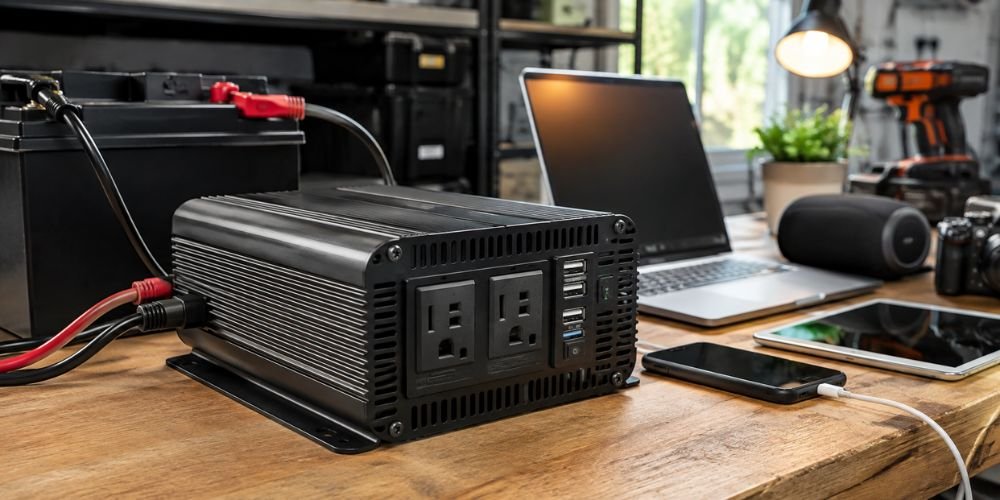
To choose the correct power inverter size, calculate the total wattage of the devices you will run and select an inverter that can provide at least 25% more continuous power than your load. For devices with motors or compressors, choose an inverter with a surge rating 2 to 3 times higher than the device’s running wattage.
National Battery Supply offers battery and backup power options, while the sizing decision itself comes down to continuous load, startup surge and the battery system feeding the inverter.
How Many Watts Will Run at the Same Time?
Every appliance has a running wattage, meaning the power it uses during normal operation. The inverter’s continuous rating needs to cover the combined running load of the devices expected to stay on together. Victron recommends sizing around the highest expected simultaneous AC demand rather than one appliance in isolation.
A short load list makes this easier:
- Note every appliance that may use inverter power.
- Check the nameplate or manual for running watts.
- Add only the devices likely to operate together.
- Separate normal running demand from startup demand.
A laptop with lights creates a very different load from a microwave, refrigerator and pump running at the same time.
Why Does Startup Surge Change the Answer?
Motors and compressors can pull considerably more power for a moment when they start. Refrigerators, pumps, air conditioners and some power tools are common examples. That short peak is why an inverter needs both a suitable continuous rating and enough surge capacity.
If a refrigerator starts while a television and lights are already running, the inverter must cope with the refrigerator’s startup demand plus those existing loads. Looking only at the refrigerator’s normal wattage can leave the system undersized.
For RV setups, the article on RV inverter basics explains how stored battery power reaches standard AC equipment.
How Much Extra Inverter Capacity Is Sensible?
Some margin is sensible because real use rarely stays identical every day. Warmer operating conditions, another small appliance or a future upgrade can change the load. Victron also recommends headroom for temperature effects, load variation and future expansion.
That does not mean buying the biggest inverter available. A much larger unit may require heavier cabling and greater DC current capability than the existing battery bank can support.
The better target is an inverter that comfortably carries the realistic continuous load while its published surge rating covers the hardest startup event.
Does Battery Voltage Affect Inverter Size?
Yes. An inverter may provide 120 volt AC output while drawing power from a 12, 24 or 48 volt battery system. Higher power at a lower battery voltage means more DC current. That affects cable size, protection and the battery’s ability to deliver the load.
Victron notes that higher system voltages reduce current in larger installations. It also states that the battery, BMS, conductors and DC protection need to support continuous and surge demand.
This is why inverter wattage cannot be chosen separately from the battery system. Off Grid Inverters need to match the battery voltage plus the current the bank can safely supply.
Does a Bigger Battery Mean a Bigger Inverter?
Not automatically. Battery capacity mainly affects how long equipment can run. Inverter rating describes how much AC power can be supplied at a particular moment.
A large battery bank can provide long runtime through a modest inverter. A powerful inverter connected to an inadequate battery can still shut down when a heavy load starts.
Repeatedly pulling a battery too low can also create reliability problems. The guide to deep discharge explains why usable battery capacity matters when backup loads stay on for extended periods.
What Inverter Size Fits Common Uses?
The examples below are starting points rather than purchase recommendations. Appliance labels and inverter specifications should control the final decision.
A 1,000 watt inverter is not automatically suitable for every appliance rated below 1,000 watts. Surge capacity, battery voltage and the manufacturer’s continuous rating still need checking.
Should the Inverter Be Pure Sine Wave?
Waveform is separate from wattage. Pure sine wave inverters more closely reproduce normal utility AC power and are generally preferred for sensitive electronics, motors, chargers and appliances with electronic controls.
A correctly sized inverter can still be a poor match if the connected equipment does not tolerate its waveform. The inverter documentation plus appliance requirements should be checked before installation.
When Should the System Be Checked Professionally?
Higher power installations deserve more than a quick wattage total. Cable gauge, fusing, battery discharge limits, ventilation and grounding can affect safe operation. Larger RV, marine, solar and home backup systems may need a qualified installer.
The real test is not whether the inverter starts an appliance once. The system needs to carry its normal load repeatedly without overheating wiring, tripping protection or pushing the battery beyond its operating limits.
Conclusion
The right inverter starts with a realistic load list. Continuous wattage should cover what runs together. Surge capacity should handle the hardest startup event. Battery voltage and discharge capability must support both.
National Battery Supply’s Power Inverter Stations can narrow the options once those numbers are known. A few minutes spent checking the load first can prevent an inverter that is too small, unnecessarily large or mismatched to the battery bank.
Featured Posts
Request more information
National Battery Supply delivers dependable energy storage solutions tailored to commercial, industrial, and government applications. Our catalog ranges from custom battery manufacturing and UPS systems, portable power stations, to high-capacity solutions like whole-home battery energy storage systems (BESS) and scalable containerized energy storage units- engineered for reliability, flexibility, and rapid deployment.
We support critical infrastructure, telecom, data centers, healthcare, and remote operations with power systems built for performance in demanding environments. Whether it’s deep cycle batteries, lithium forklift replacements, OEM portable power kits, solar backups, and large-scale energy storage systems. We provide tailored solutions with short lead times, custom branding, and bulk pricing.
Our team also specializes in helping integrators, resellers, and developers source complete battery systems for residential microgrids, off-grid power stations, and industrial container setups. Whether you need to back up a home, energize a remote site, or manage facility-wide loads, we have the scalable energy storage options to match.
Contact us today to learn how our advanced power systems can reduce downtime, extend operational capacity, and support your long-term energy goals.
National Battery Supply is a reputable manufacturer specializing in custom battery solutions. With over 20 years of experience, we can manage all your power needs.
Batteries
Compliance
Copyright 2026 © National Battery Supply | UEI: Z66VQCUPCGL3 CAGE: 9UK94